Trace jazz from the Jazz Age and Swing Era through bebop, cool jazz, hard bop, modal and free jazz,
fusion and today's wide-ranging scenes. Each decade places styles in context with musical
characteristics, key recordings, historical moments and notable players.
Jazz history is not a sequence of sealed boxes: styles overlap, travel, borrow from one another
and continue to develop. The dates below are useful landmarks, not boundaries.
Artist profiles sit in the decade of a defining breakthrough, not their birth year
or necessarily their first paid performance.
Each profile follows the musician's wider career and names overlapping genres. Open
“Recordings and videos” for landmark works; the year identifies the original recording
or release, not necessarily the date of the linked performance. YouTube opens only when
you choose to play a video, and availability may vary by country. Portraits include
reuse credits; where Wikipedia offers only a non-free photograph, a biography link
is provided instead of copying that photograph.
Scroll down through the years, pictures and stories, or choose a decade on the left.
1920–1929
The Jazz Age
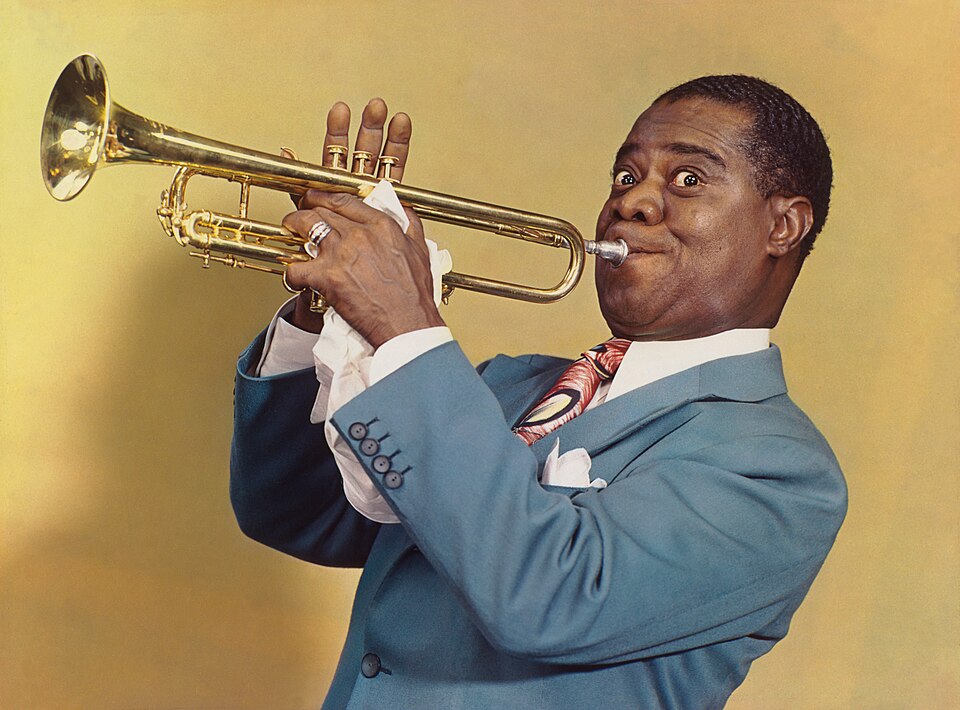
Louis Armstrong — Harry Warnecke / Gus Schoenbaechler, National Portrait Gallery; public domain.
Image details
Jazz recordings reached a growing national audience in the 1920s. New Orleans musicians,
Chicago bands and Harlem's dance halls helped turn a regional music into a defining sound of
modern popular culture. The decade also brought the Harlem Renaissance, a major flowering of
Black arts and intellectual life.
— Louis Armstrong recorded with King Oliver's Creole Jazz Band.
Armstrong's later small-group recordings gave the soloist a central role in jazz.
— Armstrong began recording with the Hot Five. The sessions
became landmarks for improvisation, phrasing and the expressive range of the trumpet.
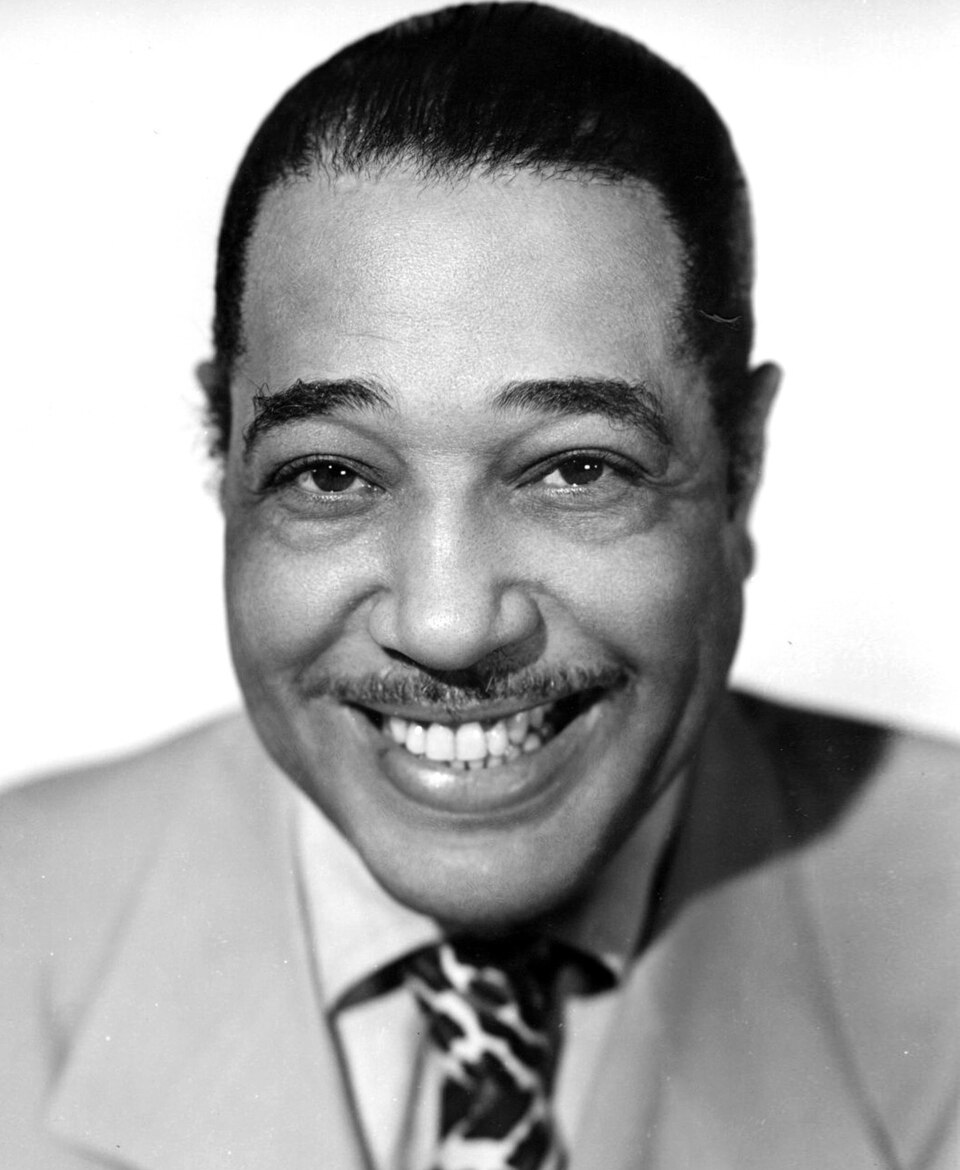
— Duke Ellington's orchestra began its celebrated Cotton Club
residency in Harlem, broadcast to listeners beyond New York.
Genre family: early jazz and dance-band styles
Traditional jazz
New Orleans ensemble jazz: collective improvisation, a strong pulse
and interweaving trumpet, clarinet and trombone lines.
Chicago-style jazz: small-group playing that gave soloists more room
and reflected the movement of New Orleans musicians north.
Stride piano: a solo-piano style whose alternating bass notes and chords
supported agile, syncopated melodies.
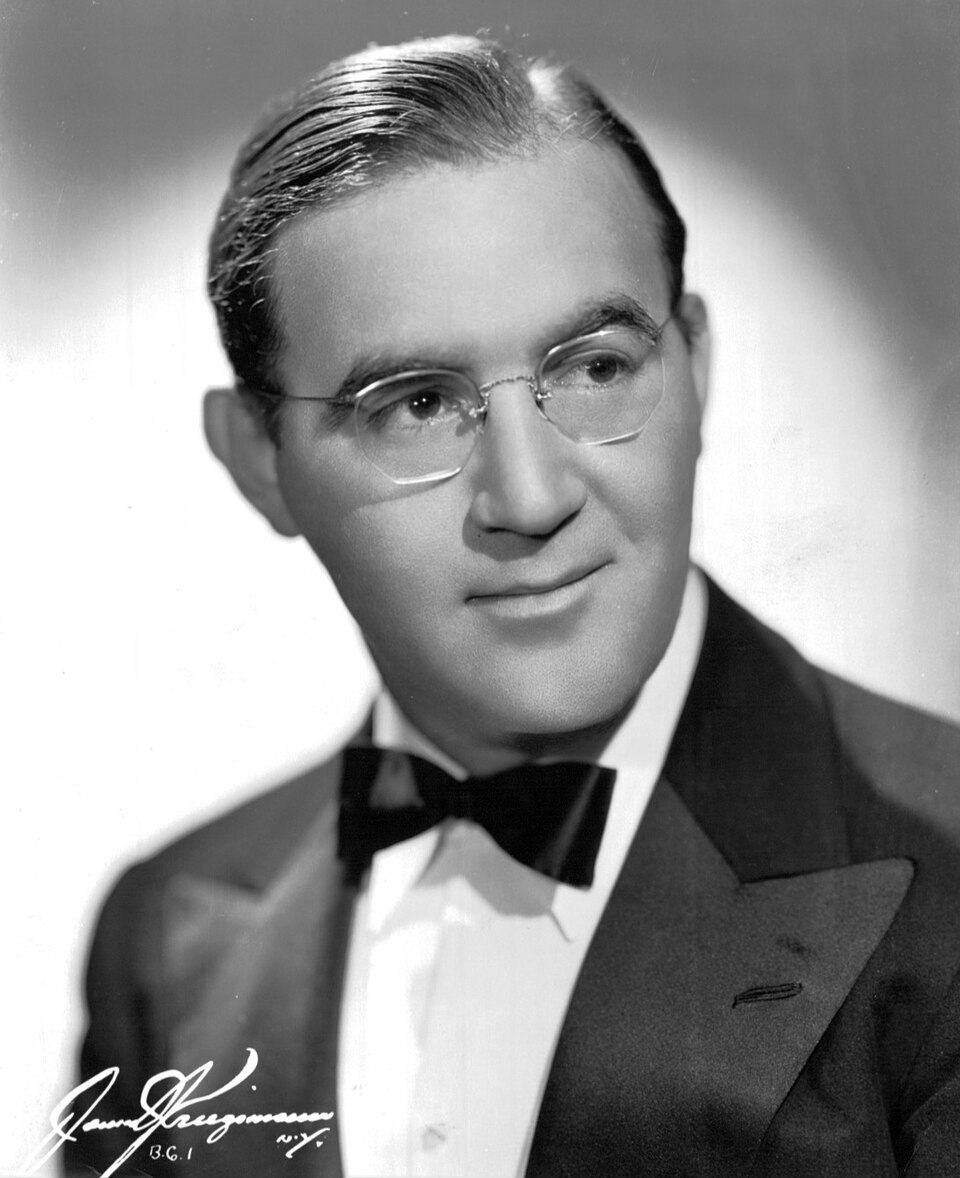
Benny Goodman — photo by Jammes J. Kriegsmann; public domain.
Image detailsDuke Ellington — photographer unknown; public-domain publicity photograph.
Image details
Big-band swing became a dominant popular music in the 1930s and continued into the 1940s.
Arranged brass and reed sections traded riffs over a steady four-beat dance pulse, while
soloists improvised within the arrangement. Radio, touring bands and ballrooms connected
regional scenes to a national audience.
— Benny Goodman's Los Angeles Palomar Ballroom appearance
is often marked as a turning point in the swing boom.
— Count Basie's Kansas City band developed a relaxed,
riff-based style and a strong rhythm section, while Duke Ellington expanded orchestral jazz.
Genre family: swing and big-band jazz
Big-band swing
New York orchestras: detailed arrangements and star soloists.
Kansas City swing: blues-based riffs, head arrangements and extended
solo space.
Vocal swing: singers such as Billie Holiday and Ella Fitzgerald
brought conversational phrasing to popular standards.
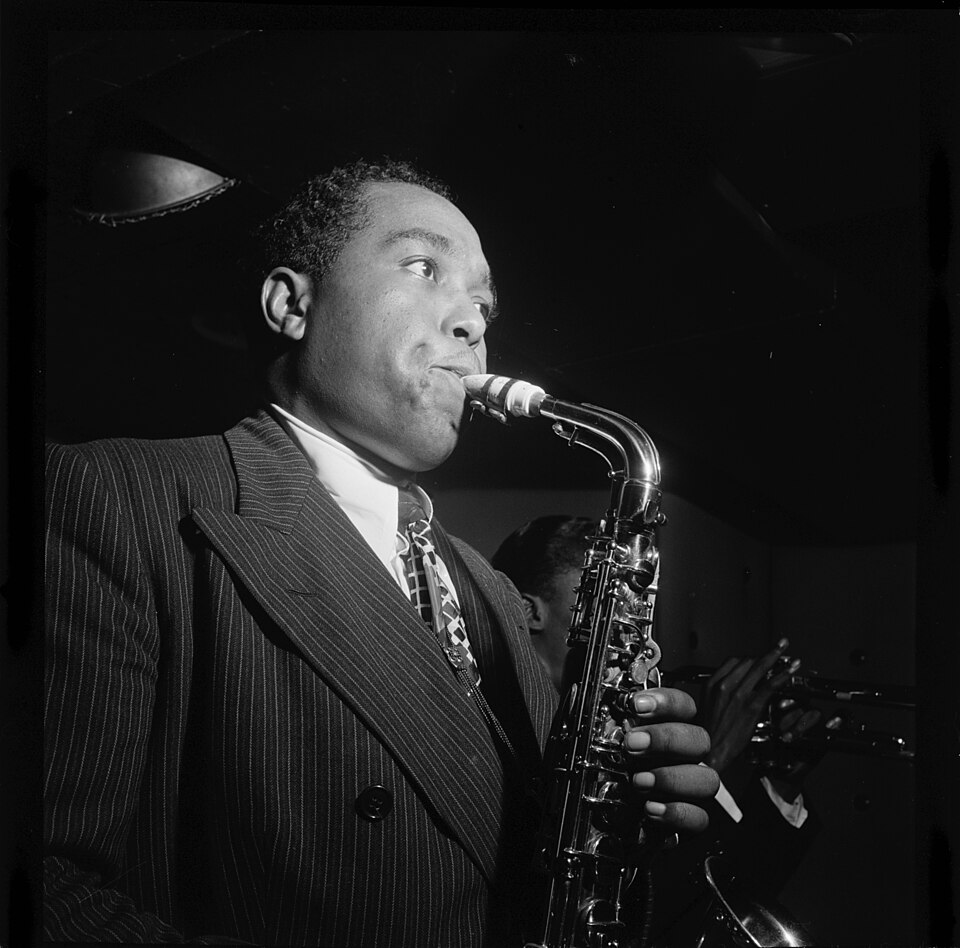
Charlie Parker — photo by William P. Gottlieb; public domain.
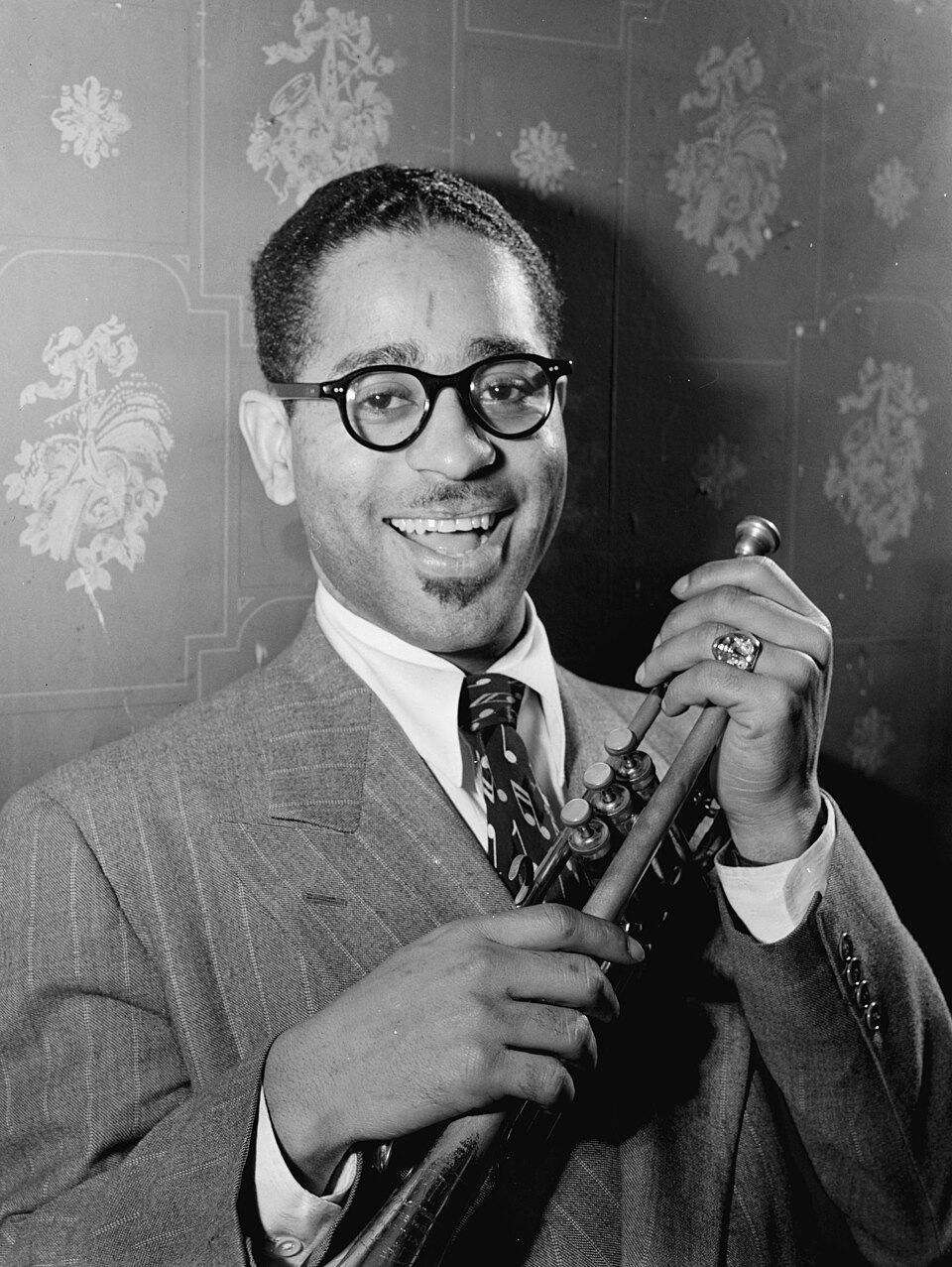
Image detailsDizzy Gillespie — photo by William P. Gottlieb; public domain.
Image details
Bebop grew in the early 1940s as musicians created a modern, small-group music for close
listening as well as dancing. Fast tempos, asymmetrical phrases, intricate melodies and
reharmonised standards gave improvisers new possibilities. Jam sessions at Harlem clubs
were central to its development.
— Charlie Parker, Dizzy Gillespie, Thelonious Monk
and others shaped bebop's language in New York.
— Gillespie and Cuban percussionist Chano Pozo recorded
Manteca, an influential meeting of big-band jazz and Afro-Cuban rhythm.
— Miles Davis began the sessions later collected as
Birth of the Cool, a key reference point for cool jazz.
Genre family: modern jazz
Bebop
Small-combo bebop: horn-led ensembles, walking bass and nimble
ride-cymbal time with harmonically adventurous solos.
Cool jazz
A broad, varied approach associated with controlled dynamics, contrapuntal writing,
unusual instrument combinations and a lighter tone; not every musician or recording fit
one sound.
West Coast jazz: one related scene, with arranged chamber textures
alongside improvisation.
Afro-Cuban jazz
Jazz improvisation meets Cuban rhythmic traditions, including layered percussion
and clave-based patterns.
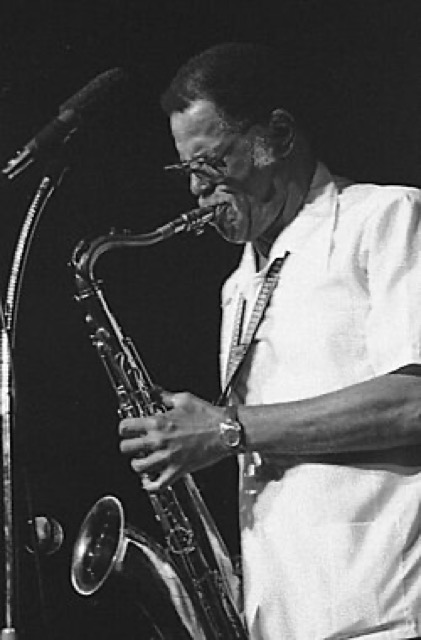
Dexter Gordon in concert at the Colonial Tavern, Toronto, August 19, 1978 — Jean-Luc (Flickr user), concert photo, Toronto, August 19, 1978; CC BY-SA 2.0.
Image source and credits. Resized for display.
Dexter Gordon
Bebop / Hard Bop
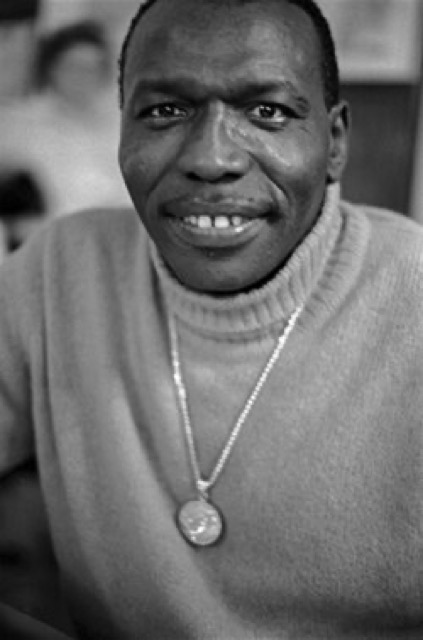
Dexter Gordon was a tenor saxophonist active from 1940 whose behind-the-beat phrasing and quotation-filled solos helped establish bebop's tenor saxophone vocabulary alongside Charlie Parker's generation. He recorded "Long Tall Dexter" in 1947 and later spent much of the 1960s performing in Europe. His 1962 Blue Note album Go! is a frequently cited recording of his catalog, and he later portrayed a jazz musician in the 1986 film Round Midnight.
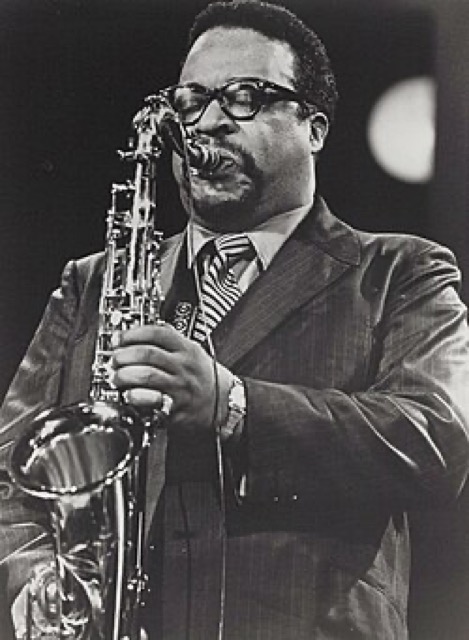
Gene Ammons, nicknamed 'Jug,' was a Chicago tenor saxophonist who joined trumpeter King Kolax's band in 1943 and Billy Eckstine's band in 1944, playing alongside Charlie Parker and Dexter Gordon. The son of boogie-woogie pianist Albert Ammons, he had an R&B chart hit with "Red Top" in 1947 and went on to a long solo recording career for Prestige Records, known for bluesy ballads and soul jazz grooves, interrupted twice by prison terms for narcotics convictions.
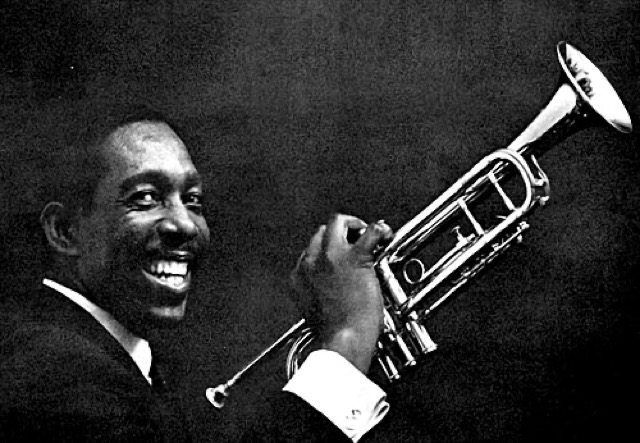
Texas-born trumpeter Kenny Dorham played in Billy Eckstine's big band in the mid-1940s and joined Charlie Parker's quintet in 1948-49, succeeding Miles Davis. He later co-founded Art Blakey's Jazz Messengers and led his own hard bop groups through the 1950s and into the 1960s. Critic Gary Giddins noted that Dorham's name had become associated with the word 'underrated.' He composed the jazz standard 'Blue Bossa' and died in 1972.
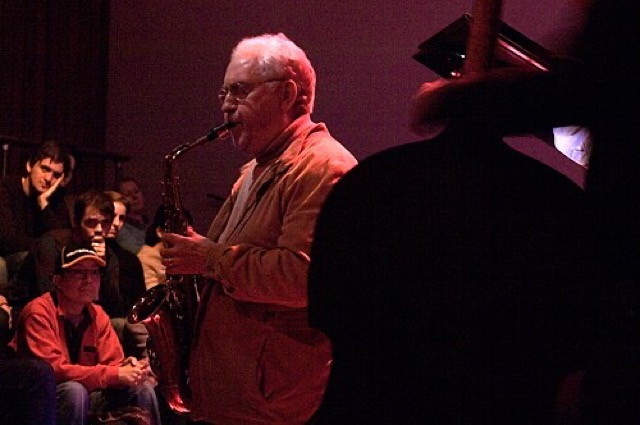
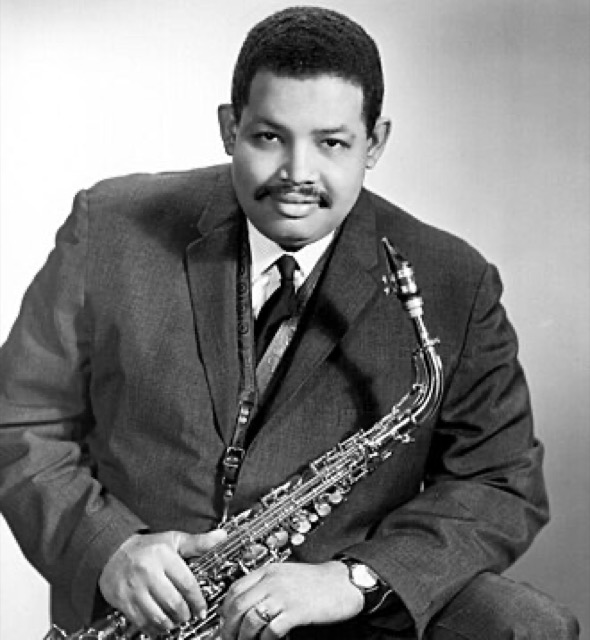
Confirmed portrait of Lee Konitz, verified via Commons API imageinfo/extmetadata. — Hans Peter Schaefer (reserv-a-rt.de); CC BY 3.0.
Image source and credits. Resized for display.
Lee Konitz
Cool jazz alto saxophone
Chicago-born alto saxophonist Lee Konitz studied with pianist Lennie Tristano and joined Claude Thornhill's orchestra in 1947, recording his composition 'Subconscious-Lee' in 1949 and taking part in Miles Davis's Birth of the Cool sessions that same year. Unlike many contemporaries, his phrasing avoided a Charlie Parker-derived sound, instead emphasizing melodic lines associated with what became known as cool jazz. He kept performing and recording into the 2010s, until his death in 2020.
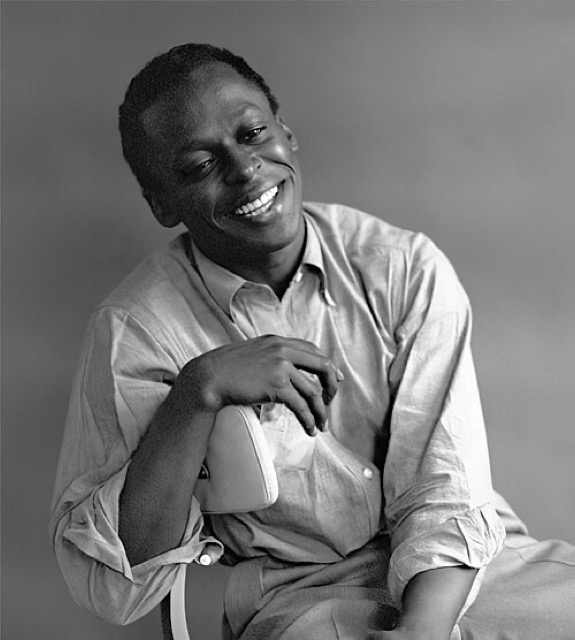
Confirmed portrait of Miles Davis, verified via Commons API imageinfo/extmetadata. — Tom Palumbo (New York City, USA); CC BY-SA 2.0.
Image source and credits. Resized for display.
Miles Davis
Bebop / cool jazz / modal jazz trumpet
Illinois-born trumpeter Miles Davis joined Charlie Parker's quintet in 1945 and led the nonet sessions later released as Birth of the Cool in 1949-50. He subsequently led groups through hard bop and, by 1959, modal jazz on Kind of Blue, followed by a mid-1960s quintet and 1970s work incorporating electric instruments. He recorded and toured across five decades until his death in 1991.
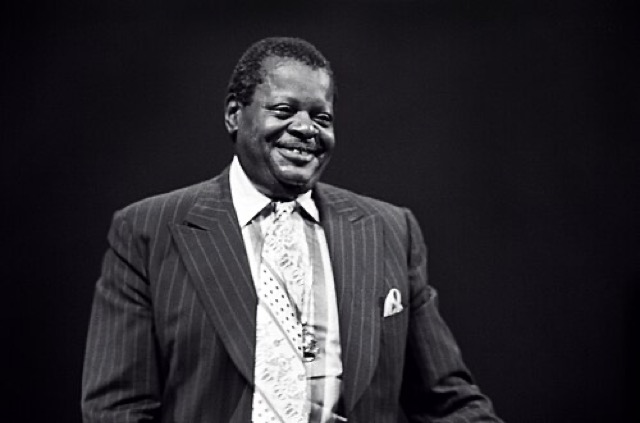
Confirmed portrait of Oscar Peterson, verified via Commons API imageinfo/extmetadata. — Tom Marcello (Webster, New York, USA); CC BY-SA 2.0.
Image source and credits. Resized for display.
Oscar Peterson
Swing / bebop-influenced mainstream jazz piano
Montreal-born pianist Oscar Peterson was signed by producer Norman Granz after a 1949 Carnegie Hall appearance with Jazz at the Philharmonic, an engagement that introduced him to American audiences and anchored his career with Verve Records. His trio recordings through the 1950s and 1960s combined swing-era rhythmic drive with bebop harmony. He continued performing until his death in 2007, and received Canada's Order of Canada among other honors.
A Boston-born alto and tenor saxophonist who emerged alongside the earliest bebop pioneers, he was frequently compared to Charlie Parker for his fluent, hard-swinging lines, though he cultivated a sharper, more percussive attack of his own. Prolific almost to a fault, he recorded hundreds of sessions across five decades, excelling especially in saxophone battles with fellow tenor giants. His tireless touring and recording schedule kept him steadily active on the bebop and hard-bop circuit for decades.
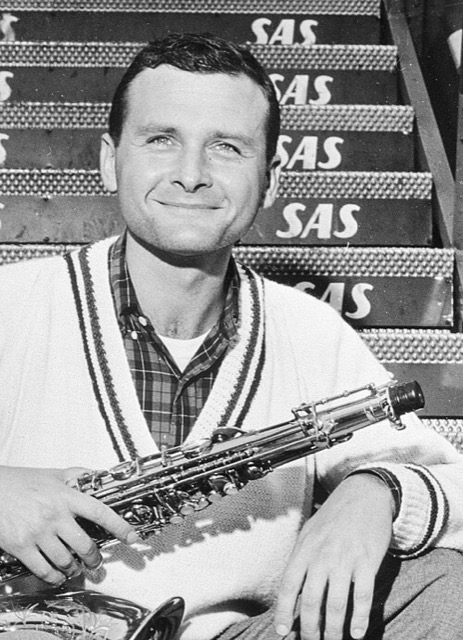
Stan Getz — SAS Scandinavian Airlines; Public Domain.
Image source and credits. Resized for display.
Stan Getz
Cool Jazz / Bossa Nova (Tenor Saxophone)
A Philadelphia-born tenor saxophonist celebrated for his breathy, lyrical tone, he first gained attention in Woody Herman's late-1940s saxophone section before building a long solo career defined by melodic restraint rather than harmonic density. His early-1960s immersion in Brazilian rhythms introduced bossa nova to American audiences and produced some of the era's best-selling jazz records. Despite personal struggles, his warm, vibrato-light sound remained instantly recognizable across cool jazz, bebop, and Latin-inflected recordings alike.
A Cleveland-born pianist, arranger, and composer, he helped translate bebop's harmonic language into lush, singable themes that bridged swing-era elegance with modern jazz complexity. Writing for Dizzy Gillespie's big band and leading his own sextets, he penned tunes that became bebop standards performed by countless musicians. Though his career was cut short by personal hardship and an early death, his compositions and voicings quietly shaped how a generation of arrangers approached melody and harmony.
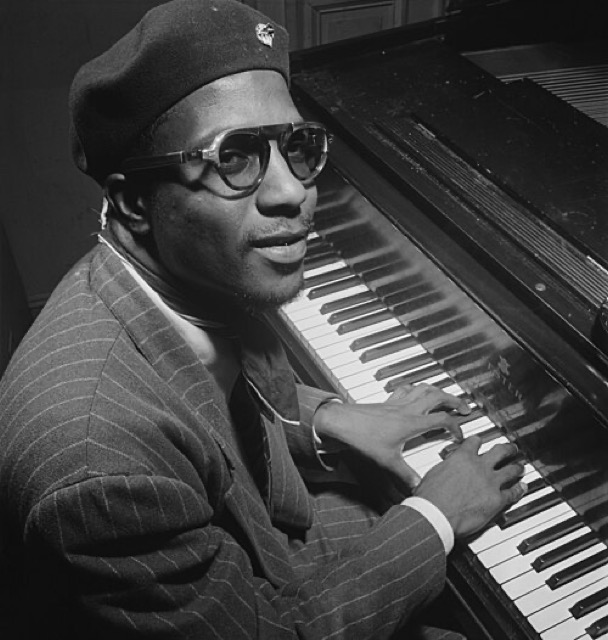
Thelonious Monk — William P. Gottlieb; Public Domain.
Image source and credits. Resized for display.
Thelonious Monk
Bebop (Piano / Composer)
A Rocky Mount, North Carolina-born pianist and composer who served as house musician at Minton's Playhouse during bebop's incubation, he developed an angular, dissonant, rhythmically idiosyncratic style unlike anything else in jazz. Initially dismissed by some critics as eccentric, his compositions became foundational jazz standards performed across generations. Known for his percussive touch, unexpected silences, and whole-tone runs, he later led celebrated quartets and received broad recognition, including a famous Time magazine cover feature.
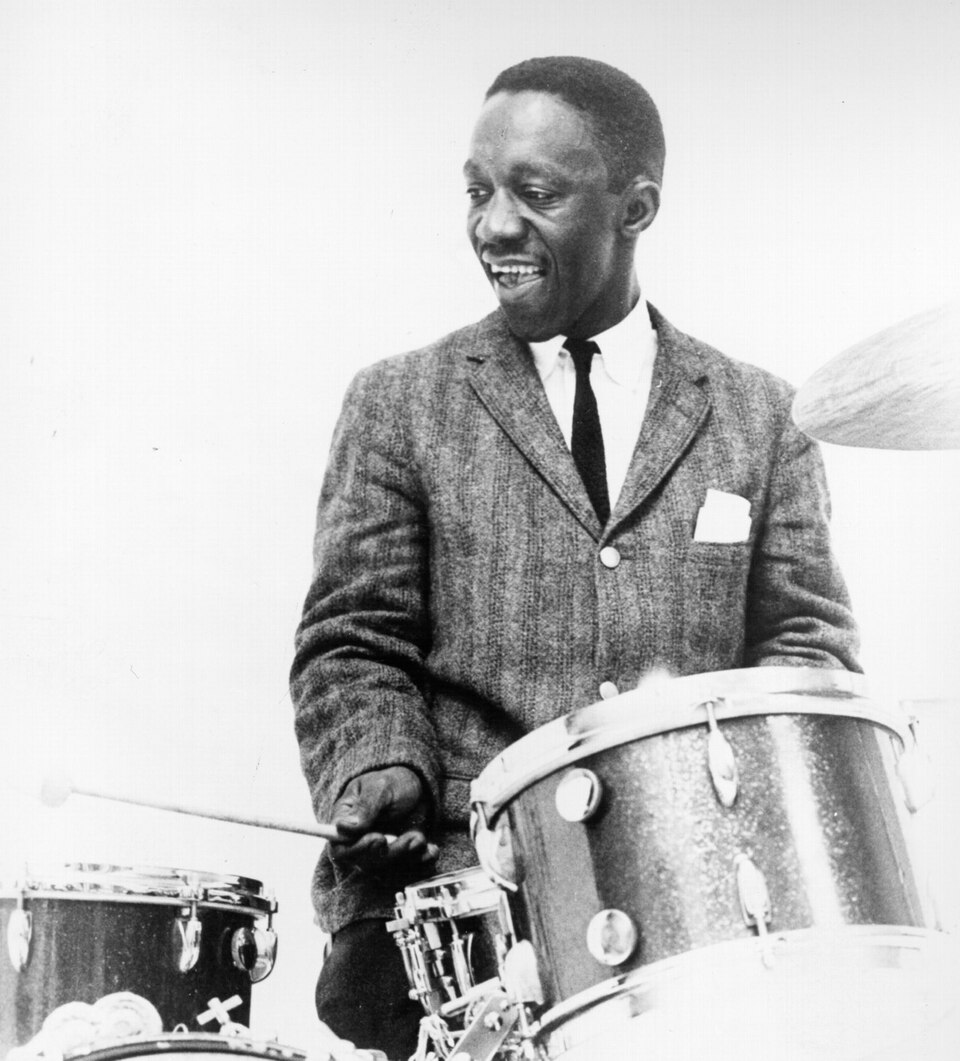
Art Blakey — distributed by Shaw Artists Corporation; public domain.
Image details
Hard bop grew from bebop while drawing strongly on blues, gospel, rhythm and blues, and Black
church traditions. Composers and improvisers developed more blues-rooted melodies and
percussive, soulful grooves. Cool and West Coast styles continued alongside it; there was no
single sound that defined the decade.
— Art Blakey's Jazz Messengers began the run that made
the group a leading workshop for hard-bop players and composers.
— Lee Morgan joined the Jazz Messengers as a teenager;
his trumpet playing and compositions became closely associated with the hard-bop scene.
— Miles Davis's Kind of Blue brought modal
improvisation to a landmark recording, while Dave Brubeck's Time Out explored
unusual meters.
Genre family: modern jazz branches
Hard bop
Soul jazz: a groove-forward branch with blues and gospel inflections,
often featuring organ, saxophone or trumpet.
Jazz Messengers school: a hard-bop lineage built through bands,
touring and mentorship.
Cool and West Coast jazz
Arranged ensemble color and restrained phrasing continued to develop, alongside
lively, blues-based small-group work.
Modal jazz
Improvisers spend longer exploring a scale or mode instead of moving rapidly through
chord changes, creating more open harmonic space.
Five articles follow Morgan's life, music and place in jazz.
Loading the articles…
Pannonica de Koenigswarter: the Jazz Baroness
Pannonica became a close supporter of musicians in the bebop and hard-bop circles, including
Thelonious Monk and Charlie Parker. Explore her story through photographs and music references.
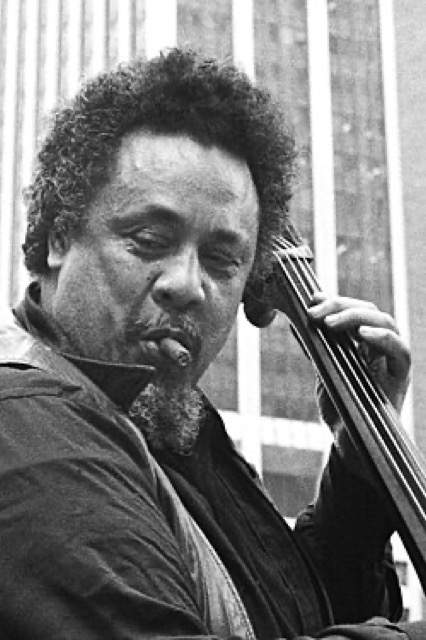
Portrait of Charles Mingus performing, 1976 — Tom Marcello (Webster, New York); cropped/retouched derivative by Commons user Emdee; CC BY-SA 2.0.
Image source and credits. Resized for display.
Charles Mingus
Hard Bop / Post-Bop
Charles Mingus was a double bassist, composer, and bandleader active from the 1940s who became a central figure in modern jazz composition. He blended gospel, blues, and classical structure in extended, loosely scored arrangements for shifting ensembles. His 1959 album Mingus Ah Um, released on Columbia, paired swinging blues with commentary on segregation in pieces like "Fables of Faubus." He also co-founded Debut Records to control his own recordings and publishing.
Julian 'Cannonball' Adderley was an alto saxophonist who began recording as a leader in 1955 and became a defining voice of hard bop and soul jazz. He played in Miles Davis's sextet on the 1959 album Kind of Blue before returning to lead his own quintet. His group's blend of gospel-tinged grooves and improvisation produced the crossover hit "Mercy, Mercy, Mercy," helping bring jazz to wider radio and record-buying audiences in the 1960s.
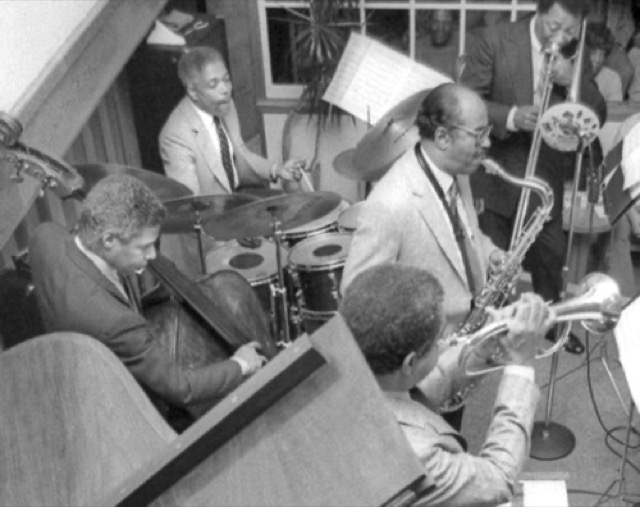
Curtis Fuller — Brian McMillen (Wikimedia user Brianmcmillen), from a 1985 photo of the Jazztet at Kimball's, San Francisco; CC BY-SA 4.0.
Image source and credits. Resized for display.
Curtis Fuller
Hard Bop
Curtis Fuller was a Detroit-born trombonist who moved to New York in 1957 and quickly became an in-demand hard bop sideman and leader. He played on John Coltrane's Blue Train and numerous Jazz Messengers and Blue Note sessions of the late 1950s and 1960s. His own 1959 album Blues-ette, featuring the title track he composed, remains a frequently cited hard bop recording for its melodic trombone lines and ensemble interplay.
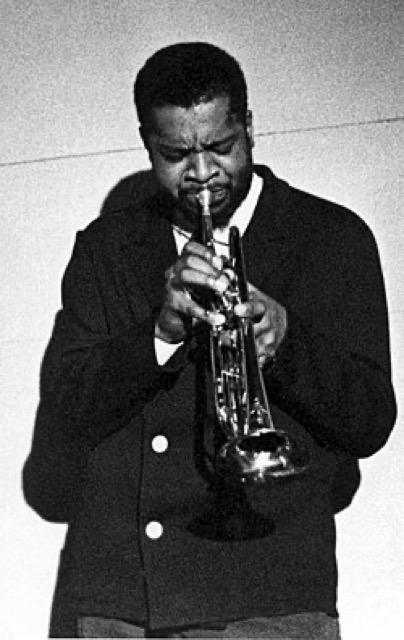
Donald Byrd at the Blue Note club, Brussels, November 1, 1964 — Mallory1180 (own work); CC BY-SA 4.0.
Image source and credits. Resized for display.
Donald Byrd
Hard Bop / Jazz Fusion
Donald Byrd was a Detroit-trained trumpeter who moved to New York in 1955 and became a prolific Blue Note sideman and leader through the late 1950s and 1960s. In the 1970s he shifted toward jazz-funk fusion, forming the group the Blackbyrds and scoring a commercial hit with the title track of his 1973 album Black Byrd, produced by the Mizell Brothers. He was also a longtime music educator at Howard University and other institutions.
Duke Pearson was an Atlanta-born pianist, composer, and arranger active from the 1950s who became closely associated with Blue Note Records during the 1960s, where he worked as a producer and musical director in addition to recording as a leader. His compositions "Jeannine" and "Cristo Redentor" were popularized by other Blue Note artists, including Cannonball Adderley and Donald Byrd, and have been performed widely as jazz standards since their introduction.
George Russell was a composer, theorist, and bandleader whose career began in 1947 when Dizzy Gillespie commissioned his composition "Cubano Be, Cubano Bop." In 1953 he published the Lydian Chromatic Concept of Tonal Organization, a theoretical framework that influenced modal jazz approaches used by Miles Davis and Bill Evans. His own recordings, including "Ezz-thetic" and "All About Rosie," combined big-band writing with modal and avant-garde elements across a decades-long career.
Gerry Mulligan was a baritone saxophonist, composer, and arranger whose professional career began in 1946 writing for Gene Krupa's and Claude Thornhill's big bands. He contributed arrangements to Miles Davis's Birth of the Cool sessions of 1949-50, then formed a pianoless quartet in 1952 that became a model for cool jazz small groups. His recordings with trumpeter Chet Baker, including "My Funny Valentine," remain frequently cited performances of the style.
Georgia-born, New Jersey-raised tenor saxophonist Hank Mobley began recording professionally around 1950, played with Max Roach's group, and became a founding member of Art Blakey's Jazz Messengers in 1954. Critic Leonard Feather described his tone as sitting between John Coltrane's intensity and Lester Young's lightness. He continued recording for Blue Note Records into the 1960s, including the 1960 album Soul Station, before his death in 1986.
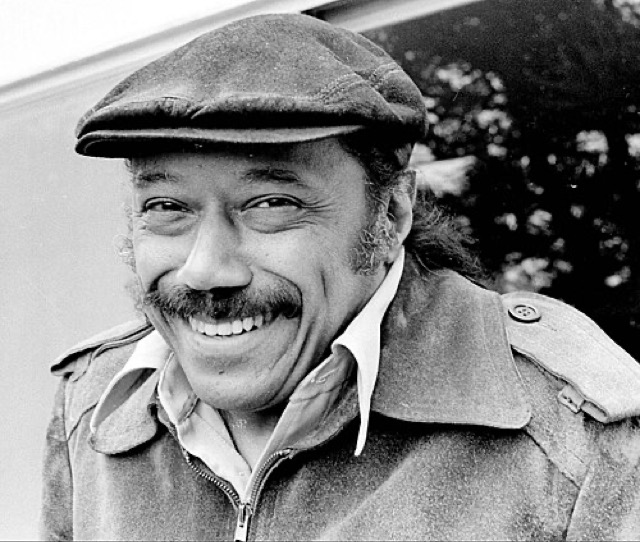
Confirmed portrait of Horace Silver, verified via Commons API imageinfo/extmetadata. — Dimitri Savitski; CC BY-SA 3.0.
Image source and credits. Resized for display.
Horace Silver
Hard bop piano
Connecticut-born pianist Horace Silver was discovered by saxophonist Stan Getz in 1950 and moved to New York, later co-founding Art Blakey's Jazz Messengers in 1954 before leading his own quintet. His compositions combined bebop harmony with blues- and gospel-influenced rhythm, a style associated with hard bop. He recorded for Blue Note Records for nearly three decades, including the 1964 album Song for My Father, and died in 2014.
Confirmed portrait of Jackie McLean, verified via Commons API imageinfo/extmetadata. — Brian McMillen; CC BY-SA 3.0.
Image source and credits. Resized for display.
Jackie McLean
Hard bop / post-bop alto saxophone
Harlem-born alto saxophonist Jackie McLean grew up near Thelonious Monk, Bud Powell and Charlie Parker and first recorded with Miles Davis's group around 1951-52. He recorded as a leader for Prestige and Blue Note Records through the 1950s and 1960s, developing a sharp-toned style that moved toward freer improvisation on albums such as Let Freedom Ring. He later taught jazz at the Hartt School in Hartford, Connecticut, until his death in 2006.
Confirmed portrait of Lee Morgan, verified via Commons API imageinfo/extmetadata. — Herbert Behrens / Anefo (Nationaal Archief); CC BY-SA 3.0 NL.
Image source and credits. Resized for display.
Lee Morgan
Hard bop trumpet
Philadelphia-born trumpeter Lee Morgan recorded with Dizzy Gillespie's big band in 1956 at age 18 and released his own debut album the same year, before joining Art Blakey's Jazz Messengers. He remained a Blue Note Records artist through the 1960s, recording primarily in a hard bop idiom with some later post-bop material. His 1963 recording 'The Sidewinder' reached outside typical jazz audiences. He was shot and killed in 1972 at age 33.
Born in Springfield, Massachusetts, this alto saxophonist studied at Juilliard and emerged from the bebop lineage shaped directly by Charlie Parker, whose widow he later married. After stints with Jimmy Raney, Dizzy Gillespie, and Quincy Jones, and several years leading bands in Paris, he returned to the U.S. and fronted a celebrated working quintet for decades. His soaring, blues-drenched solo on Billy Joel's 1977 hit introduced his unmistakable tone to a massive mainstream pop audience.
A Philadelphia-born drummer whose crisp, propulsive brushwork and press-roll accents became a blueprint for modern jazz timekeeping, he rose to prominence anchoring Miles Davis's mid-1950s quintet alongside Coltrane, Garland, and Chambers. His crackling cymbal work and rim-shot accents drove hard-bop sessions for Blue Note, Prestige, and Riverside throughout the era. Later he led his own groups and mentored younger drummers, remaining a widely cited influence on modern drum stylists.
Sonny Rollins — Distributed by Milestone Records (photographer uncredited); Public Domain.
Image source and credits. Resized for display.
Sonny Rollins
Hard Bop / Bebop (Tenor Saxophone)
Raised in Harlem, this tenor saxophonist forged a muscular, thematically inventive improvisational style rooted in bebop but pushed toward long-form motivic development. His mid-1950s recordings, cut alongside Clifford Brown, Max Roach, and briefly John Coltrane, cemented his reputation as a leading tenor improviser. Known for extended unaccompanied cadenzas and calypso-inflected melodies, he took periodic sabbaticals from performing, famously practicing alone on the Williamsburg Bridge, yet remained active into his later decades.
In 1959, jazz opened several doors at once. Miles Davis’s Kind of Blue made modal jazz
a compelling alternative to improvising through rapid chord changes: spacious scales and unhurried
melodic invention gave the soloists room to shape the music. Ornette Coleman’s The Shape of Jazz to Come
proposed a different freedom. His piano-less quartet loosened the authority of predetermined harmony,
letting melody and the musicians’ responses carry the performance. These were not the same experiment,
but together they enlarged the possibilities of small-group jazz.
Innovation also came through rhythm, composition and the blues. Dave Brubeck’s Time Out
brought unusual meters to a broad audience, especially through Paul Desmond’s “Take Five”.
Charles Mingus’s Mingus Ah Um drew gospel, blues and jazz memory into sharply individual
ensemble writing. Meanwhile, hard bop was anything but exhausted: Horace Silver, Donald Byrd,
Jackie McLean and their collaborators kept developing its muscular swing, memorable themes and
blues feeling. Cannonball Adderley’s live San Francisco recordings point toward soul jazz,
while Bill Evans’s Portrait in Jazz explores another intimate trio language.
The significance of 1959 lies in this coexistence, not in a single style replacing all the others.
Established orchestras, singers and new voices shared the landscape with records that would become
landmarks. The year also saw Ronnie Scott’s club open in London and Miles Davis beaten and arrested
outside Birdland — reminders that artistic possibility unfolded within a much less equal social world.
Explore the recordings below with their recording and release dates kept distinct: some music made
in 1959 reached listeners only years later.
63 albums across 46 artist entries ·
43 first released in 1959 · 20 first released after 1959 ·
9 include material recorded before 1959.
Each album has two song selections checked against its track listing.
Listening links open directly on YouTube in a new tab; no videos are embedded here.
All 126 links go directly to individual songs, not searches.
Portraits depict the named album artist or credited participant, not the cover.
Listening checks, 5 November 2026: 87 videos returned an OK, embeddable player response.
For 35 more, song, artist and album were checked against YouTube’s search metadata and
public video title/channel/embed metadata (oEmbed); playback status could not be rechecked after YouTube
rate-limited the research. Some links use reissues or compilations of the album recordings.
Availability and regional restrictions can change.
Adderley fronts a quartet with Wynton Kelly on piano, alternating two rhythm teams: Paul Chambers and Jimmy Cobb on four original tracks, and the brothers Percy and Albert “Tootie” Heath on three. Critical opinion was mixed: AllMusic’s Ken Dryden found Adderley in top form, while the Penguin Guide considered the date fairly ordinary.
18 & 20 October 1959, live at the Jazz Workshop, San Francisco
Released
1959
Original label
Riverside
Released in 1959
Taped before a packed club audience, this live set is credited by NPR with launching soul jazz, linking bebop to a funkier groove. Producer Orrin Keepnews kept Adderley’s spoken introductions and called the record the birth of contemporary live recording; its success led him and other producers to record many more club dates. Time reported about 50,000 copies sold by May 1960.
August 1960 (reissued in 1964 as Cannonball & Coltrane)
Original label
Mercury
Released in 1960
Adderley’s last Mercury album pairs him with John Coltrane, Wynton Kelly, Paul Chambers and Jimmy Cobb — in effect Miles Davis’s band without its leader, weeks before the Kind of Blue sessions. AllMusic’s Scott Yanow highlighted the contrast between Coltrane’s intensity and Adderley’s buoyant alto. Recorded in 1959, it was not issued until 1960.
Wikipedia list entry: Chet Baker – Chet (Riverside)
Chet
Chet Baker — Distributed by Joe Glaser's Associated Booking Corporation. Photographer uncredited and unknown.; Public domain. Image source and credits. Album artist portrait; not album artwork or necessarily a 1959 photograph.
Recorded
30 December 1958 & 19 January 1959, Reeves Sound, New York
Released
1959
Original label
Riverside
Released in 1959Recorded from 1958
Although Baker was by then as well known for singing, this ballad programme is entirely instrumental. His sidemen include Bill Evans, Pepper Adams, Herbie Mann, Kenny Burrell and Paul Chambers, with Connie Kay or Philly Joe Jones on drums; Evans, Chambers and Jones had played together in Miles Davis’s band in 1958. AllMusic’s Dave Nathan recommended it as a showcase for Baker’s lyrical sound.
Wikipedia list entry: Art Blakey and the Jazz Messengers – Holiday for Skins (Blue Note)
Holiday for Skins
Art Blakey — distributed by Shaw Artists Corporation; public domain. Image detailsAlbum artist portrait; not album artwork or necessarily a 1959 photograph.
Recorded
9 November 1958, Manhattan Towers, New York
Released
early June 1959, as two separate LPs (BLP 4004 and 4005)
Original label
Blue Note
Released in 1959Recorded from 1958
Two related volumes built around three drummers: Blakey, Philly Joe Jones and Art Taylor, joined by Donald Byrd, Ray Bryant and Wendell Marshall. Recorded late in 1958, the volumes were reunited on one CD in 2006.
Wikipedia list entry: Dave Brubeck – Time Out (album) (Columbia)
Time Out
Dave Brubeck — Jack de Nijs for Anefo / Anefo; CC BY-SA 3.0. Image source and credits. Album artist portrait; not album artwork or necessarily a 1959 photograph.
Recorded
25 June, 1 July & 18 August 1959, Columbia 30th Street Studio
Released
14 December 1959
Original label
Columbia
Released in 1959
Columbia agreed to the experiment only after the quartet first recorded a conventional album, Gone with the Wind. Drawing on rhythms Brubeck encountered during a State Department tour, Time Out explored meters such as 9/8, 6/4 and 5/4. It became the first jazz album to sell a million copies, and Paul Desmond’s “Take Five” the first million-selling jazz single. Later recognition includes the National Recording Registry (2005), the Grammy Hall of Fame (2009) and RIAA double-platinum certification (2011).
Wikipedia list entry: Donald Byrd – Fuego, Byrd in Hand (Blue Note)
Fuego
Donald Byrd at the Blue Note club, Brussels, November 1, 1964 — Mallory1180 (own work); CC BY-SA 4.0. Image source and credits. Resized for display. Album artist portrait; not album artwork or necessarily a 1959 photograph.
Recorded
4 October 1959, Van Gelder Studio
Released
July 1960
Original label
Blue Note
Released in 1960
Byrd’s quintet with Jackie McLean, Duke Pearson, Doug Watkins and Lex Humphries. AllMusic’s Michael G. Nastos heard Byrd edging from hard bop toward post-bop, while the Penguin Guide praised McLean but found the tunes less interesting. Recorded in 1959; released the following year.
Track listing: Wikipedia: album track listing. Videos are external YouTube references; availability can vary by country and change over time.
Sources: Wikipedia: Fuego (Donald Byrd album). Cited material: AllMusic review cited by Wikipedia; The Penguin Guide to Jazz, cited by Wikipedia.
Byrd in Hand
Donald Byrd at the Blue Note club, Brussels, November 1, 1964 — Mallory1180 (own work); CC BY-SA 4.0. Image source and credits. Resized for display. Album artist portrait; not album artwork or necessarily a 1959 photograph.
Recorded
31 May 1959, Van Gelder Studio
Released
1959
Original label
Blue Note
Released in 1959
A hard-bop blowing session that the Penguin Guide called typical of Blue Note. AllMusic noted that none of the new tunes became standards but praised the group’s consistently creative solos.
Track listing: Wikipedia: album track listing. Videos are external YouTube references; availability can vary by country and change over time.
Sources: Wikipedia: Byrd in Hand. Cited material: AllMusic review cited by Wikipedia; The Penguin Guide to Jazz, cited by Wikipedia.
Sonny Clark
Wikipedia list entry: Sonny Clark – My Conception (Blue Note)
My Conception
Art Blakey — distributed by Shaw Artists Corporation; public domain. Image detailsAlbum personnel portrait; not album artwork or necessarily a 1959 photograph.
Recorded
29 March 1959 (CD bonus tracks: 8 December 1957), Van Gelder Studio
Released
1979, first in Japan (GXF 3056)
Original label
Blue Note
Released in 1979
Sonny Clark’s 1959 quintet session with Donald Byrd, Hank Mobley, Paul Chambers and Art Blakey stayed in the vault for two decades. It includes an alternate take of “Royal Flush”. AllMusic’s Michael G. Nastos rated it just below Clark’s best, praising writing that gives his bandmates room. It belongs to 1959 by recording date only.
Wikipedia list entry: Ornette Coleman – Tomorrow Is the Question! (OJC) The Shape of Jazz to Come (Atlantic)
Tomorrow Is the Question!
Ornette Coleman — Frank Schindelbeck, CC BY-SA 3.0 DE. License · Image detailsAlbum artist portrait; not album artwork or necessarily a 1959 photograph.
Recorded
16 January, 23 February & 9–10 March 1959, Contemporary’s studio, Los Angeles
Released
November 1959 (the 1959 list cites the OJC reissue)
Original label
Contemporary
Released in 1959
Subtitled “The New Music of Ornette Coleman!”, Coleman’s second album was his last for Contemporary before his Atlantic series. Don Cherry is joined by bassists Percy Heath and Red Mitchell and drummer Shelly Manne.
Ornette Coleman — Frank Schindelbeck, CC BY-SA 3.0 DE. License · Image detailsAlbum artist portrait; not album artwork or necessarily a 1959 photograph.
Recorded
22 May 1959, Radio Recorders, Hollywood
Released
November 1959
Original label
Atlantic
Released in 1959
Coleman’s Atlantic debut and first album with Don Cherry, Charlie Haden and Billy Higgins. John Lewis of the Modern Jazz Quartet helped arrange the Atlantic contract, and producer Nesuhi Ertegun proposed the title instead of Coleman’s “Focus on Sanity”. Its later recognition includes the National Recording Registry (2012), the Grammy Hall of Fame (2015) and a place in all three editions of Rolling Stone’s 500 greatest albums.
Track listing: Wikipedia: album track listing. Videos are external YouTube references; availability can vary by country and change over time.
Sources: Wikipedia: The Shape of Jazz to Come. Cited material: Library of Congress National Recording Registry, cited by Wikipedia; Grammy Hall of Fame, cited by Wikipedia.
Miles Davis
Wikipedia list entry: Miles Davis – Kind of Blue (Columbia)
Kind of Blue
Confirmed portrait of Miles Davis, verified via Commons API imageinfo/extmetadata. — Tom Palumbo (New York City, USA); CC BY-SA 2.0. Image source and credits. Resized for display. Album artist portrait; not album artwork or necessarily a 1959 photograph.
Recorded
2 March & 22 April 1959, Columbia 30th Street Studio
Released
17 August 1959
Original label
Columbia
Released in 1959
Davis led John Coltrane, Cannonball Adderley, Bill Evans, Paul Chambers and Jimmy Cobb, with Wynton Kelly on “Freddie Freeloader”. Building on Milestones, he based the album entirely on modes, giving players scales rather than dense chord changes; Coltrane later extended that approach. Often called the greatest jazz album, it was among the first 50 recordings added to the National Recording Registry in 2002 and was certified five-times platinum by the RIAA in 2019.
Track listing: Wikipedia: album track listing. Videos are external YouTube references; availability can vary by country and change over time.
Sources: Wikipedia: Kind of Blue. Cited material: Library of Congress National Recording Registry, cited by Wikipedia; RIAA, cited by Wikipedia.
Walter Davis
Wikipedia list entry: Walter Davis – Davis Cup (album) (Blue Note)
Davis Cup
Walter Davis Jr. — Carlo Rondinelli; CC BY 2.0. Image source and credits. Album artist portrait; not album artwork or necessarily a 1959 photograph.
Recorded
2 August 1959, Van Gelder Studio
Released
June 1960
Original label
Blue Note
Released in 1960
Pianist Walter Davis Jr.’s debut as a leader and his only Blue Note album as leader, built from six of his own tunes. AllMusic’s Stephen Thomas Erlewine called it a terrific hard-bop date and noted that Davis did not lead another session until 1979.
An understated set of standards and originals, including Dorham’s “Lotus Blossom”, which Sonny Rollins had earlier recorded as “Asiatic Raes”. AllMusic awarded 4½ stars and the Penguin Guide called it a minor masterpiece.
Track listing: Wikipedia: album track listing. Videos are external YouTube references; availability can vary by country and change over time.
Sources: Wikipedia: Quiet Kenny. Cited material: AllMusic review cited by Wikipedia; The Penguin Guide to Jazz, cited by Wikipedia.
Duke Ellington
Wikipedia list entry: Duke Ellington – The Ellington Suites (OJC) Jazz Party, Festival Session, Anatomy of a Murder (Columbia)
The Ellington Suites
Duke Ellington — photographer unknown; public-domain publicity photograph. Image detailsAlbum artist portrait; not album artwork or necessarily a 1959 photograph.
Recorded
25 February, 1 & 14 April 1959; 27 April 1971; 5 October 1972
Released
1976
Original label
Pablo (the 1959 list cites the OJC reissue)
Released in 1976
Its 1959 link is The Queen’s Suite, written by Ellington and Billy Strayhorn for Queen Elizabeth II. Only one pressing was made for her, and the music was not commercially issued in Ellington’s lifetime. Pablo combined it with two later suites in 1976, and the album won a Grammy for Best Jazz Performance by a Big Band.
Duke Ellington — photographer unknown; public-domain publicity photograph. Image detailsAlbum artist portrait; not album artwork or necessarily a 1959 photograph.
Recorded
19 & 25 February 1959, Columbia 30th Street Studio
Released
1959
Original label
Columbia
Released in 1959
Ellington’s orchestra welcomes guests including Dizzy Gillespie and Jimmy Rushing, and two tracks use a nine-player percussion section. “Satin Doll” and “Fillie Trillie” were added only on later Columbia reissues.
Track listing: Wikipedia: album track listing. Videos are external YouTube references; availability can vary by country and change over time.
Sources: Wikipedia: Jazz Party. Cited material: Gary Giddins, The Village Voice, cited by Wikipedia.
Festival Session
Duke Ellington — photographer unknown; public-domain publicity photograph. Image detailsAlbum artist portrait; not album artwork or necessarily a 1959 photograph.
Recorded
8 September 1959, Columbia 30th Street Studio
Released
1959
Original label
Columbia
Released in 1959
According to Irving Townsend’s liner notes, Ellington waited until the festival season ended and then recorded the new material in a single morning session. AllMusic’s Ken Dryden called it a long-overlooked gem in Ellington’s discography.
Track listing: Wikipedia: album track listing. Videos are external YouTube references; availability can vary by country and change over time.
Sources: Wikipedia: Festival Session. Cited material: AllMusic review cited by Wikipedia; Original liner notes, quoted by Wikipedia.
Anatomy of a Murder
Duke Ellington — photographer unknown; public-domain publicity photograph. Image detailsAlbum artist portrait; not album artwork or necessarily a 1959 photograph.
Recorded
29 May & 1–2 June 1959, Radio Recorders, Los Angeles
Released
1959 (soundtrack album)
Original label
Columbia
Released in 1959
Ellington and Billy Strayhorn scored Otto Preminger’s courtroom film, and Ellington appears on screen as Pie Eye. Film historians cited by Wikipedia call the score a landmark: the first significant Hollywood film music by African Americans used as non-diegetic underscore. The score won three Grammy Awards for 1959. The 1959 list links to the film; the dates here are for the soundtrack.
Wikipedia list entry: Bill Evans Trio – Portrait in Jazz (Riverside)
Portrait in Jazz
Bill Evans — Steve Schapiro; Public domain. Image source and credits. Album artist portrait; not album artwork or necessarily a 1959 photograph.
Recorded
28 December 1959, Reeves Sound, New York
Released
1960
Original label
Riverside
Released in 1960
The first of only two studio albums by Evans’s trio with Scott LaFaro and Paul Motian. LaFaro’s bass becomes almost an equal voice to the piano, a step toward the interplay of Sunday at the Village Vanguard. It was recorded at the very end of 1959 and released in 1960; mono and stereo editions used different takes of “Autumn Leaves”.
Wikipedia list entry: João Gilberto – Chega de Saudade (album) (Odeon)
Chega de Saudade
João Gilberto — Tuca Vieira from São Paulo, Brazil; CC BY-SA 2.0. Image source and credits. Album artist portrait; not album artwork or necessarily a 1959 photograph.
Recorded
1959
Released
1959 (Wikipedia gives 14 April)
Original label
Odeon
Released in 1959
João Gilberto’s debut album, produced by Antônio Carlos Jobim, is often credited as the first bossa nova album. It entered the Grammy Hall of Fame and became an inaugural member of the Latin Grammy Hall of Fame in 2001, and Brazilian critics’ polls have ranked it among the country’s greatest records.
Wikipedia list entry: Jimmy Giuffre – The Easy Way (album) (Verve)
The Easy Way
Ray Brown — Kay Musical Instrument Company; Public domain. Image source and credits. Album personnel portrait; not album artwork or necessarily a 1959 photograph.
Recorded
6 & 7 August 1959, Universal Recording, Chicago
Released
1959
Original label
Verve
Released in 1959
Intimate chamber jazz from Giuffre’s trio with guitarist Jim Hall and bassist Ray Brown. All About Jazz praised the close interplay and noted Brown’s fit outside Oscar Peterson’s trio.
Wikipedia list entry: Benny Golson – Gone with Golson, Groovin' with Golson (OJC)
Gone with Golson
Benny Golson — Brianmcmillen; CC BY-SA 3.0. Image source and credits. Album artist portrait; not album artwork or necessarily a 1959 photograph.
Recorded
20 June 1959, Van Gelder Studio
Released
1959
Original label
New Jazz (the 1959 list cites the OJC reissue)
Released in 1959
Golson’s fifth album puts his tenor saxophone with Curtis Fuller’s trombone and a rhythm section of Ray Bryant, Tommy Bryant and Al Harewood. AllMusic’s Scott Yanow described it as a fine example of late-1950s hard bop.
Wikipedia list entry: Chico Hamilton – The Three Faces of Chico (Warner Bros.) Gongs East! (Discovery)
The Three Faces of Chico
Chico Hamilton — Professor Bop; CC BY 2.0. Image source and credits. Album artist portrait; not album artwork or necessarily a 1959 photograph.
Recorded
25 February 1959, Los Angeles
Released
1959
Original label
Warner Bros.
Released in 1959
As the title suggests, the album presents Hamilton as drummer, singer and bandleader. Billboard called it versatile with radio appeal, and AllMusic’s Bruce Eder rated it one of Hamilton’s most varied albums.
Chico Hamilton — Professor Bop; CC BY 2.0. Image source and credits. Album artist portrait; not album artwork or necessarily a 1959 photograph.
Recorded
29–30 December 1958, Los Angeles
Released
1959
Original label
Warner Bros. (the 1959 list names Discovery)
Released in 1959Recorded from 1958
Recorded at the end of 1958, the album is notable for some of Eric Dolphy’s earliest recordings. AllMusic’s Scott Yanow recommended it for Dolphy’s short solos.
Wikipedia list entry: Coleman Hawkins – Hawk Eyes, (OJC) Coleman Hawkins with the Red Garland Trio (Prestige)
Hawk Eyes
Coleman Hawkins — Unknown authorUnknown author; Public domain. Image source and credits. Album artist portrait; not album artwork or necessarily a 1959 photograph.
Recorded
3 April 1959, Van Gelder Studio
Released
1959
Original label
Prestige (the 1959 list cites the OJC reissue)
Released in 1959
Hawkins leads a jam-oriented session. AllMusic gave it four stars, describing long jams with plenty of fireworks.
Coleman Hawkins — Unknown authorUnknown author; Public domain. Image source and credits. Album artist portrait; not album artwork or necessarily a 1959 photograph.
Recorded
12 August 1959, Van Gelder Studio
Released
1959 (Swingville SVLP 2001)
Original label
Swingville (Prestige)
Released in 1959
Hawkins leads Red Garland’s trio through simple originals. AllMusic’s Scott Yanow counted it among his better Prestige-family sessions, pairing him with a then-modern rhythm section.
Wikipedia list entry: Johnny Hodges and Duke Ellington – Back to Back: Duke Ellington and Johnny Hodges Play the Blues, Side by Side (Verve)
Back to Back: Duke Ellington and Johnny Hodges Play the Blues
Duke Ellington — photographer unknown; public-domain publicity photograph. Image detailsAlbum artist portrait; not album artwork or necessarily a 1959 photograph.
Recorded
20 & 26 February 1959, New York
Released
1959
Original label
Verve
Released in 1959
A small-group blues meeting in which Ellington plays piano behind his longtime alto star. The Penguin Guide awarded it its top rating. Three tracks from the sessions were issued on Side by Side.
Duke Ellington — photographer unknown; public-domain publicity photograph. Image detailsAlbum artist portrait; not album artwork or necessarily a 1959 photograph.
Recorded
14 August 1958 & February 1959, New York
Released
1959
Original label
Verve
Released in 1959Recorded from 1958
Despite joint billing, this is mainly a Johnny Hodges album: Ellington plays on only three tracks, with Billy Strayhorn at the piano elsewhere. Guests include Ben Webster, Roy Eldridge, Harry “Sweets” Edison and Jo Jones. It combines 1958 material with three Back to Back session tracks and has remained in print.
Wikipedia list entry: Milt Jackson and John Coltrane – Bags & Trane (Atlantic)
Bags & Trane
John Coltrane — Hugo van Gelderen / Anefo; CC0. CC0 · Image detailsAlbum artist portrait; not album artwork or necessarily a 1959 photograph.
Recorded
15 January 1959, Atlantic Studios, New York
Released
mid-July 1961
Original label
Atlantic
Released in 1961
The only joint album by Milt Jackson and John Coltrane. Jackson led the session, but by its 1961 release Coltrane had become a bigger star and Atlantic gave his name equal prominence. A contemporary DownBeat review felt the pairing could have gelled better.
Wikipedia list entry: Wynton Kelly – Kelly Blue (Contemporary)
Kelly Blue
Wynton Kelly — Shaw Artists Corporation, New York; Public domain. Image source and credits. Album artist portrait; not album artwork or necessarily a 1959 photograph.
Recorded
19 February & 10 March 1959
Released
1959
Original label
Riverside
Released in 1959
Kelly with Paul Chambers and Jimmy Cobb — Miles Davis’s rhythm section — plus Nat Adderley, Bobby Jaspar and Benny Golson on some tracks. AllMusic’s Scott Yanow wrote that it proved Kelly, best known as an accompanist, was also a strong soloist.
Wikipedia list entry: Stan Kenton – Standards in Silhouette (Capitol)
Standards in Silhouette
Stan Kenton — The Library of Congress; Public domain. Image source and credits. Album artist portrait; not album artwork or necessarily a 1959 photograph.
Recorded
21–22 September 1959
Released
1959 (CD 1998)
Original label
Capitol
Released in 1959
A Stan Kenton orchestra album of standards in which every arrangement was written by Bill Mathieu rather than by Kenton.
16 October 1959 (one track 11 October 1957), Van Gelder Studio
Released
August 1960
Original label
New Jazz
Released in 1960Recorded from 1957
Mostly recorded in 1959, with one 1957 track, and released in 1960. AllMusic described Lateef’s music as meditative, accessible and rhythmically rich, already reaching beyond conventional jazz.
Abbey Lincoln’s fourth album. All About Jazz called it a breakthrough, hearing songs of sorrow and injustice shaped by the coming civil-rights era; PopMatters likewise noted that these concerns would remain central throughout her life.
Track listing: Wikipedia: album track listing. Videos are external YouTube references; availability can vary by country and change over time.
Sources: Wikipedia: Abbey Is Blue. Cited material: AllMusic review cited by Wikipedia; All About Jazz and PopMatters, cited by Wikipedia.
Jackie McLean
Wikipedia list entry: Jackie McLean – New Soil, Swing, Swang, Swingin' (Blue Note)
New Soil
Confirmed portrait of Jackie McLean, verified via Commons API imageinfo/extmetadata. — Brian McMillen; CC BY-SA 3.0. Image source and credits. Resized for display. Album artist portrait; not album artwork or necessarily a 1959 photograph.
Recorded
2 May 1959, Van Gelder Studio
Released
August 1959
Original label
Blue Note
Released in 1959
McLean’s first Blue Note release, though not his first session for the label, with Donald Byrd, Walter Davis Jr., Paul Chambers and Pete La Roca. AllMusic’s Steve Huey heard early signs of McLean pushing beyond bebop.
Track listing: Wikipedia: album track listing. Videos are external YouTube references; availability can vary by country and change over time.
Sources: Wikipedia: New Soil. Cited material: AllMusic review cited by Wikipedia.
Swing, Swang, Swingin'
Confirmed portrait of Jackie McLean, verified via Commons API imageinfo/extmetadata. — Brian McMillen; CC BY-SA 3.0. Image source and credits. Resized for display. Album artist portrait; not album artwork or necessarily a 1959 photograph.
Recorded
20 October 1959, Van Gelder Studio
Released
28 March 1960
Original label
Blue Note
Released in 1960
A quartet date with Walter Bishop Jr., Jimmy Garrison and Art Taylor. AllMusic described it as less groundbreaking than McLean’s modernist work, but as an invigorated session at the start of an exceptional run.
Wikipedia list entry: Charles Mingus – Mingus Ah Um, Mingus Dynasty (Columbia), Blues and Roots (Atlantic)
Mingus Ah Um
Portrait of Charles Mingus performing, 1976 — Tom Marcello (Webster, New York); cropped/retouched derivative by Commons user Emdee; CC BY-SA 2.0. Image source and credits. Resized for display. Album artist portrait; not album artwork or necessarily a 1959 photograph.
Recorded
5–12 May 1959, Columbia 30th Street Studio
Released
October 1959
Original label
Columbia
Released in 1959
Mingus’s first Columbia album, described by the Penguin Guide as a tribute to his ancestors. “Goodbye Pork Pie Hat” honours Lester Young, who had just died, “Better Git It in Your Soul” draws on gospel, and “Fables of Faubus” targets the Arkansas governor who resisted school integration. It entered the Grammy Hall of Fame in 2013 and placed 380th on Rolling Stone’s 2020 list of the 500 greatest albums.
Track listing: Wikipedia: album track listing. Videos are external YouTube references; availability can vary by country and change over time.
Sources: Wikipedia: Mingus Ah Um. Cited material: The Penguin Guide to Jazz, cited by Wikipedia; Grammy Hall of Fame and Rolling Stone, cited by Wikipedia.
Mingus Dynasty
Portrait of Charles Mingus performing, 1976 — Tom Marcello (Webster, New York); cropped/retouched derivative by Commons user Emdee; CC BY-SA 2.0. Image source and credits. Resized for display. Album artist portrait; not album artwork or necessarily a 1959 photograph.
Recorded
1 & 13 November 1959, Columbia 30th Street Studio
Released
May 1960
Original label
Columbia
Released in 1960
A companion to Mingus Ah Um, recorded in 1959 and released in 1960. Its title puns on the Ming dynasty and Mingus’s partly Chinese ancestry. Unedited versions of four tracks appeared in 1979, and the album entered the Grammy Hall of Fame in 1999.
Portrait of Charles Mingus performing, 1976 — Tom Marcello (Webster, New York); cropped/retouched derivative by Commons user Emdee; CC BY-SA 2.0. Image source and credits. Resized for display. Album artist portrait; not album artwork or necessarily a 1959 photograph.
Recorded
4 February 1959, Atlantic Studios, New York
Released
March 1960
Original label
Atlantic
Released in 1960
In his liner notes, Mingus wrote that Nesuhi Ertegun proposed an all-blues album after critics claimed Mingus did not swing enough. The result is an earthy, church-influenced session. DownBeat gave it four stars on release.
Track listing: Wikipedia: album track listing. Videos are external YouTube references; availability can vary by country and change over time.
Sources: Wikipedia: Blues & Roots. Cited material: Mingus’s liner notes and DownBeat, cited by Wikipedia.
Blue Mitchell
Wikipedia list entry: Blue Mitchell – Blue Soul (Riverside)
Blue Soul
Curtis Fuller — Brian McMillen (Wikimedia user Brianmcmillen), from a 1985 photo of the Jazztet at Kimball's, San Francisco; CC BY-SA 4.0. Image source and credits. Resized for display. Album personnel portrait; not album artwork or necessarily a 1959 photograph.
Recorded
24, 28 & 30 September 1959, Reeves Sound, New York
Released
1959
Original label
Riverside
Released in 1959
A trumpet-led Riverside session that AllMusic’s Michael G. Nastos rated 4½ stars and called essential for mainstream jazz fans.
Wikipedia list entry: The Modern Jazz Quartet and Orchestra – Music from Odds Against Tomorrow (United Artists)
Music from Odds Against Tomorrow
The Modern Jazz Quartet — Philips Records; Public domain. Image source and credits. Album artist portrait; not album artwork or necessarily a 1959 photograph.
Recorded
9–10 October 1959, Olmsted Sound, New York
Released
1959 (also issued as Patterns)
Original label
United Artists
Released in 1959
The Modern Jazz Quartet and a 22-piece orchestra interpret John Lewis’s film score. It was Lewis’s first score composed to follow a film’s story rather than as separate pieces. Gunther Schuller, who organized the soundtrack orchestra, said the music could stand alone apart from the film.
Wikipedia list entry: Thelonious Monk – Thelonious Alone in San Francisco, The Thelonious Monk Orchestra at Town Hall, 5 by Monk by 5 (Riverside/OJC)
Thelonious Alone in San Francisco
Thelonious Monk — William P. Gottlieb; Public Domain. Image source and credits. Resized for display. Album artist portrait; not album artwork or necessarily a 1959 photograph.
Recorded
21–22 October 1959, Fugazi Hall, San Francisco (no audience)
Released
1959
Original label
Riverside
Released in 1959
Monk’s third solo album. Most compositions had been recorded before, but the improvised blues “Bluehawk” and “Round Lights” exist only in these performances.
Thelonious Monk — William P. Gottlieb; Public Domain. Image source and credits. Resized for display. Album artist portrait; not album artwork or necessarily a 1959 photograph.
Recorded
28 February 1959, Town Hall concert, New York
Released
1959
Original label
Riverside
Released in 1959
Hall Overton arranged Monk’s tunes for a larger band, including an orchestrated version of Monk’s piano solo on “Little Rootie Tootie”. It is Charlie Rouse’s first recording with Monk; he remained until 1969. NPR praised how well the compositions stood up to reinterpretation.
Thelonious Monk — William P. Gottlieb; Public Domain. Image source and credits. Resized for display. Album artist portrait; not album artwork or necessarily a 1959 photograph.
Recorded
1, 2 & 4 June 1959
Released
1959
Original label
Riverside
Released in 1959
Monk’s quintet with Thad Jones, Charlie Rouse, Sam Jones and Art Taylor plays five of his compositions. It introduced the new “Jackie-Ing”, which Monk hummed to teach the band, and contains the first recording of “Played Twice”. The Penguin Guide called it little-known but very good.
Wikipedia list entry: Wes Montgomery – The Wes Montgomery Trio (Riverside/OJC)
The Wes Montgomery Trio
Wes Montgomery — Photo first published by Gibson. According to NPR, the photo was taken by Chuck Stewart.; Public domain. Image source and credits. Album artist portrait; not album artwork or necessarily a 1959 photograph.
Recorded
5–6 October 1959, Reeves Sound, New York
Released
March 1960 (also known as A Dynamic New Sound)
Original label
Riverside
Released in 1960
“Missile Blues” is named after the Indianapolis club where Montgomery met Riverside producer Orrin Keepnews. AllMusic’s Ronnie D. Lankford Jr. said the then-36-year-old guitarist reimagined the jazz guitar solo. Recorded in 1959 and released in 1960.
A late-1959 meeting between Mulligan’s baritone saxophone and Webster’s tenor; All That Jazz called it the most significant of Mulligan’s summit albums. NPR included it in its Basic Jazz Record Library, and Colin Larkin ranked it 448th in his All Time Top 1000 Albums in 2000. Verve issued an expanded Complete edition in 1997.
Oliver Nelson’s debut album as a leader. AllMusic said none of the tunes caught on but called it an impressive beginning that showcases his tenor playing.
Wikipedia list entry: Art Pepper – Art Pepper + Eleven – Modern Jazz Classics (Contemporary/OJC)
Art Pepper + Eleven – Modern Jazz Classics
Art Pepper — The original uploader was Mind meal at English Wikipedia.; CC BY 2.0. Image source and credits. Album artist portrait; not album artwork or necessarily a 1959 photograph.
Recorded
14 & 28 March and 12 May 1959
Released
January/February 1960 (Contemporary M3568/S7568)
Original label
Contemporary
Released in 1960
Marty Paich arranged and directed a small big band in modern-jazz standards such as “Move”, “’Round Midnight” and “Walkin’ Shoes”. Pepper recorded several dates with Paich in 1959, but this is the only one under Pepper’s name; he also plays clarinet on “Anthropology”. An expanded CD with alternate takes followed in 1988.
Wikipedia list entry: Sun Ra and His Arkestra – Jazz in Silhouette (Saturn)
Jazz in Silhouette
Sun Ra — Distributed by Impulse! Records and ABC/Dunhill Records. Photographer uncredited on the publicity photo itself; most likely Francis Ing, who is credited for the photography on Astro Black (see Discogs link above).; Public domain. Image source and credits. Album artist portrait; not album artwork or necessarily a 1959 photograph.
Recorded
6 March 1959, Chicago
Released
May 1959
Original label
Saturn (El Saturn)
Released in 1959
Sun Ra’s third studio album came from the session that also produced Sound Sun Pleasure!! It was long believed to date from 1958 until discographer Robert Campbell found the original tape box dated 6 March 1959. Critics rank it among his best Chicago-period albums, before the more avant-garde New York years. It was reissued by Impulse! in 1974.
George Russell’s orchestral portrait of the city, with Jon Hendricks providing spoken links. AllMusic’s Ken Dryden called Russell one of the most forward-thinking composer-arrangers of the 1950s, more admired by musicians than buyers, and highlighted imaginative arrangements such as “Manhattan” and the “East Side Medley”.
Track listing: Wikipedia: album track listing. Videos are external YouTube references; availability can vary by country and change over time.
Sources: Wikipedia: New York, N.Y. (album). Cited material: AllMusic review cited by Wikipedia; Down Beat and The Rolling Stone Jazz Record Guide, cited by Wikipedia.
Horace Silver
Wikipedia list entry: Horace Silver – Blowin' the Blues Away, Finger Poppin' (Blue Note)
Blowin' the Blues Away
Confirmed portrait of Horace Silver, verified via Commons API imageinfo/extmetadata. — Dimitri Savitski; CC BY-SA 3.0. Image source and credits. Resized for display. Album artist portrait; not album artwork or necessarily a 1959 photograph.
Recorded
29–30 August & 13 September 1959, Van Gelder Studio
Released
early November 1959
Original label
Blue Note
Released in 1959
Silver’s quintet with Blue Mitchell, Junior Cook, Gene Taylor and Louis Hayes, plus trio tracks. Ralph J. Gleason praised its band spirit at the time, and the Penguin Guide placed it in its Core Collection. AllMusic called it one of Silver’s all-time Blue Note classics.
Track listing: Wikipedia: album track listing. Videos are external YouTube references; availability can vary by country and change over time.
Sources: Wikipedia: Blowin' the Blues Away. Cited material: AllMusic review cited by Wikipedia; The Penguin Guide to Jazz, cited by Wikipedia; Ralph J. Gleason, cited by Wikipedia.
Finger Poppin'
Confirmed portrait of Horace Silver, verified via Commons API imageinfo/extmetadata. — Dimitri Savitski; CC BY-SA 3.0. Image source and credits. Resized for display. Album artist portrait; not album artwork or necessarily a 1959 photograph.
Recorded
31 January 1959, Van Gelder Studio
Released
mid-April 1959
Original label
Blue Note
Released in 1959
The first album by the most celebrated version of Silver’s quintet: Blue Mitchell, Junior Cook, Gene Taylor and Louis Hayes. AllMusic’s Steve Huey considered it one of Silver’s classics, blending sophisticated hard bop with blues-rooted swing.
Wikipedia list entry: Jimmy Smith – The Sermon! (Blue Note)
The Sermon!
Jimmy Smith — Bruno of Hollywood, NYC. Distributed by Joe Glaser's Associated Booking Corporation.; Public domain. Image source and credits. Album artist portrait; not album artwork or necessarily a 1959 photograph.
Recorded
25 August 1957 & 25 February 1958, Manhattan Towers, New York
Released
December 1959
Original label
Blue Note
Released in 1959Recorded from 1957
A 1959 release from earlier sessions. Like House Party, it was taped in the Manhattan Towers ballroom, which Rudy Van Gelder used for larger groups that would not fit in his Hackensack studio.
Wikipedia list entry: Sonny Stitt - Sonny Stitt Blows the Blues (Verve)
Sonny Stitt Blows the Blues
Sonny Stitt — Tom Marcello (Webster, New York, USA); CC BY-SA 2.0. Image source and credits. Resized for display. Album artist portrait; not album artwork or necessarily a 1959 photograph.
Recorded
21–22 December 1959, Los Angeles
Released
1960
Original label
Verve
Released in 1960
Stitt plays alto saxophone throughout this late-1959 session. AllMusic gave it four stars and argued that it shows he was more than a Charlie Parker imitator.
Wikipedia list entry: Frank Strozier – Fantastic Frank Strozier (Vee Jay)
Fantastic Frank Strozier
Wynton Kelly — Shaw Artists Corporation, New York; Public domain. Image source and credits. Album personnel portrait; not album artwork or necessarily a 1959 photograph.
Recorded
9 December 1959 & 3 February 1960, New York
Released
1960
Original label
Vee-Jay
Released in 1960
Strozier’s debut album uses part of the Kind of Blue rhythm section and features trumpeter Booker Little. AllMusic called it advanced hard bop and historically significant because Little, who died in 1961, made few recordings. The Penguin Guide also praised it.
Track listing: Wikipedia: album track listing. Videos are external YouTube references; availability can vary by country and change over time.
Sources: Wikipedia: Fantastic Frank Strozier. Cited material: AllMusic review cited by Wikipedia; The Penguin Guide to Jazz, cited by Wikipedia.
Dinah Washington
Wikipedia list entry: Dinah Washington- What a Diff'rence a Day Makes! (Mercury)
What a Diff'rence a Day Makes!
Dinah Washington — Associated Booking Corporation/photo by James Kriegsmann, New York; Public domain. Image source and credits. Album artist portrait; not album artwork or necessarily a 1959 photograph.
Recorded
19 February – August 1959
Released
1959
Original label
Mercury
Released in 1959
Dinah Washington’s album, arranged by Belford Hendricks and built around her hit single. The title track won the Grammy for Best R&B Performance at the second Grammy Awards in November 1959.
Wikipedia list entry: Ben Webster – Ben Webster and Associates (Verve)
Ben Webster and Associates
Ben Webster — The Library of Congress; Public domain. Image source and credits. Album artist portrait; not album artwork or necessarily a 1959 photograph.
Recorded
9 April 1959, New York
Released
1959
Original label
Verve
Released in 1959
Side one is a 20-minute “In a Mellow Tone” with Coleman Hawkins, Budd Johnson and Roy Eldridge. AllMusic described it as a relaxed meeting rather than a cutting contest, recorded less than four weeks after Lester Young’s death and serving as a tribute to him.
Wikipedia list entry: Curtis Fuller - Blues-ette (Savoy)
Blues-ette
Curtis Fuller — Brian McMillen (Wikimedia user Brianmcmillen), from a 1985 photo of the Jazztet at Kimball's, San Francisco; CC BY-SA 4.0. Image source and credits. Resized for display. Album artist portrait; not album artwork or necessarily a 1959 photograph.
Recorded
21 May 1959, Van Gelder Studio, Hackensack
Released
February 1960
Original label
Savoy
Released in 1960
Curtis Fuller’s session was recorded in 1959 and released in 1960. AllMusic gave it 4½ stars, calling it a relaxed hard-bop classic that belongs in any serious jazz collection.
Wikipedia list entry: Shel Silverstein and The Red Onion Jazz Band - Hairy Jazz (Elektra)
Hairy Jazz
Shel Silverstein — Jerry Yulsman; Public domain. Image source and credits. Album artist portrait; not album artwork or necessarily a 1959 photograph.
Recorded
Not documented in the sources consulted (released 1959)
Released
1959; Discogs lists November 1959 (Elektra EKL-176)
Original label
Elektra
Released in 1959
Before his fame as a children’s author and songwriter, Shel Silverstein sang and played kazoo with the traditional-jazz Red Onion Jazz Band. Discogs credits Bob Thompson, Joe Muranyi, Bob Greene, Steve McKnight, Frank Laidlaw and Arnie Hyman, with liner notes by Jean Shepherd. The 1959 list links to Silverstein’s biography because the album has no Wikipedia article.
Wayne Shorter — Chris Hakkens; CC BY 2.0. Image source and credits. Resized for display. Artist portrait; not album artwork or a 1959 photograph.
Recorded
9–10 November 1959, Bell Sound Studios, New York City
Released
August 1960
Original label
Vee-Jay
Debut as leaderRecorded in 1959Released in 1960
Shorter’s debut as a leader belongs here through its November 1959 recording sessions, although the album first reached listeners in 1960. Five of its six pieces are his own compositions, an early statement of the writing voice that would become central to the Jazz Messengers and Miles Davis’s later quintet. Fellow Jazz Messenger Lee Morgan joins him on trumpet; Wynton Kelly, Paul Chambers and Jimmy Cobb supply the rhythm section then associated with Davis. The programme closes with Kurt Weill’s “Mack the Knife”. Later editions also used the title Blues a la Carte.
Confirmed portrait of Lee Morgan, verified via Commons API imageinfo/extmetadata. — Herbert Behrens / Anefo (Nationaal Archief); CC BY-SA 3.0 NL. Image source and credits. Resized for display. Co-leader Lee Morgan; not Hank Mobley or album artwork.
Recorded
9 February 1958, Van Gelder Studio, Hackensack, New Jersey
Released
Late 1959
Original label
Blue Note
Released in 1959Recorded in 1958
This tenor-and-trumpet session belongs to 1959 through its release, rather than its recording date. Mobley and Morgan share the front line, with Wynton Kelly on piano, Paul Chambers on bass and Charlie Persip on drums. Four of the original LP’s five pieces are Mobley compositions; Kurt Weill and Ogden Nash’s “Speak Low” supplies the standard. Themes such as “High and Flighty” and “Peckin’ Time” place Mobley’s writing alongside the soloists’ contrasting voices. It is a useful reminder that the year’s new modal and free-jazz directions coexisted with lively, composition-led hard bop.
The original 44 artist rows and 61 albums retain the source list’s order, with Wayne Shorter’s 1959 debut sessions and Hank Mobley and Lee Morgan’s Peckin’ Time added:
Wikipedia, “1959 in jazz”, Album releases (revision 1381246976, 21 October 2026).
Dates and original labels come from each album’s Wikipedia article; where the list names a reissue label
such as OJC, the original label is shown with a note. Wikipedia text is available under
CC BY-SA 4.0; these summaries are rewritten, not copied.
Hard bop remained vital while musicians explored longer forms, unusual structures and
freer relationships between composition and improvisation. Some groups reduced chord changes
in favor of modal space; others let pulse, harmony and form become more fluid. These approaches
were distinct but often overlapped in musicians' work.
— Ornette Coleman released Free Jazz, a
double-quartet recording whose title helped name a broad avant-garde movement.
— Lee Morgan's The Sidewinder became a
widely heard hard-bop recording with a memorable blues-based groove.
— John Coltrane's A Love Supreme joined
extended improvisation with a spiritual suite-like design.
— Miles Davis recorded much of Bitches Brew,
signaling a major turn toward electric jazz; the album was released in 1970.
Genre family: avant-garde and post-bop
Avant-garde jazz
Free jazz: musicians may loosen fixed chord sequences, regular
meter or predetermined form while maintaining attentive group interaction.
Spiritual jazz: a varied current of music shaped by spiritual themes,
modal approaches and expansive improvisation.
Post-bop: a flexible modern-jazz approach that draws on hard bop, modal
jazz and avant-garde ideas without belonging to only one school.
Electric jazz and fusion: electric instruments and amplified timbres
began to blend jazz improvisation with rock and funk.
Elvin Jones was a drummer active from 1948 whose polyrhythmic style became central to jazz percussion in the 1960s. As a member of the John Coltrane Quartet from 1960 to 1966, he played on recordings including A Love Supreme and My Favorite Things. After leaving Coltrane's group, he led his own ensembles, often called the Jazz Machine, for several decades, continuing to record and tour into the 1990s and 2000s.
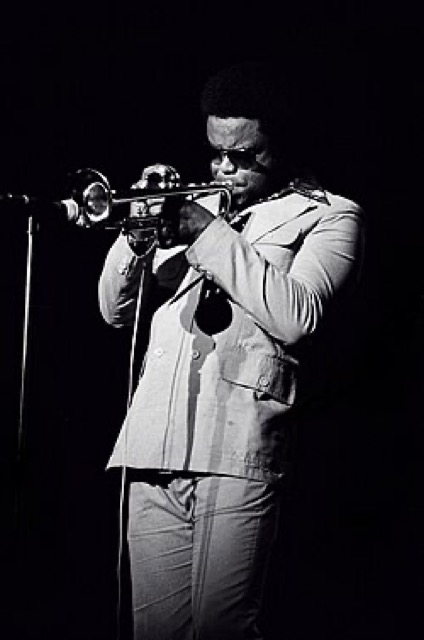
Freddie Hubbard was a trumpeter who moved to New York in 1958 and became a prominent hard bop and post-bop voice through the 1960s. He recorded as a leader for Blue Note and appeared as a sideman on sessions including John Coltrane's Ascension and Herbie Hancock's Maiden Voyage. In 1970 he recorded the title track of Red Clay, an album that moved toward jazz fusion and became one of his best-known works.
St. Louis-born guitarist Grant Green moved to New York around 1960 and began recording for Blue Note Records, pairing a single-note, horn-influenced style drawn from Charlie Parker's phrasing with hard bop and soul jazz rhythm sections. Over the decade he recorded extensively as both leader and sideman for the label. His output slowed in the 1970s due to illness, and he died in 1979 at age 43.
Confirmed portrait of McCoy Tyner, verified via Commons API imageinfo/extmetadata. — Gisle Hannemyr; CC BY-SA 3.0.
Image source and credits. Resized for display.
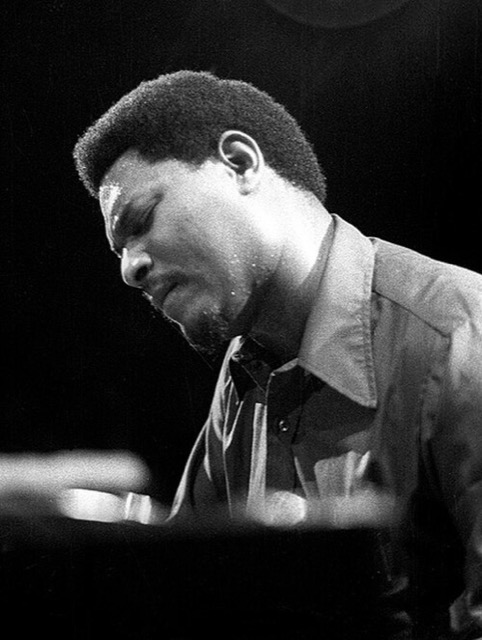
McCoy Tyner
Modal jazz / post-bop piano
Philadelphia-born pianist McCoy Tyner played with the Jazztet in 1959 before joining John Coltrane's quartet in 1960, where his left-hand voicings and modal approach shaped that group's recordings through 1965. As a leader for Impulse! and Blue Note Records, he developed a percussive style documented on albums including The Real McCoy. He continued recording and touring into the 2010s, until his death in 2020.
Hard bop / post-bop saxophone, composition and arranging
St. Louis-born saxophonist and arranger Oliver Nelson played in touring big bands through the 1950s and released his debut album as leader, Meet Oliver Nelson, in 1959. His 1961 Impulse! album The Blues and the Abstract Truth, centered on his composition 'Stolen Moments,' is frequently discussed by critics writing about arranging and composition in hard bop of that period. He later worked as a film and television composer in Los Angeles before his death in 1975.
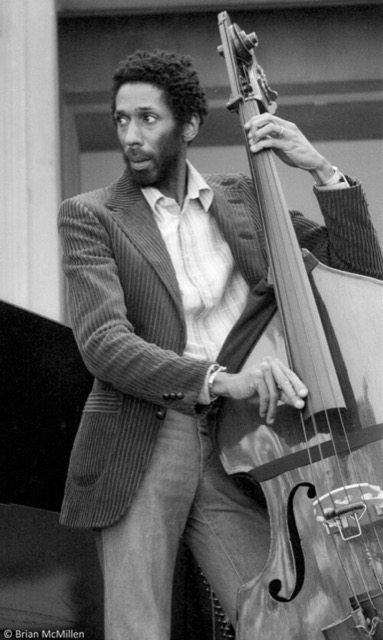
A Michigan-born bassist trained in classical cello before switching to double bass, he became the elastic rhythmic anchor of Miles Davis's mid-1960s quintet, helping pioneer the loose, conversational pulse of post-bop and modal jazz. Renowned for his woody tone, melodic counterpoint, and harmonic sophistication, he went on to appear on an enormous number of recording sessions across genres. As a bandleader he explored chamber-like small-group textures and is cited by Guinness World Records as the most recorded jazz bassist in history.
Post-Bop / Modal Jazz (Tenor & Soprano Saxophone, Composer)
A Newark-born saxophonist and composer whose searching, harmonically adventurous writing helped redefine post-bop, he first made his mark with Art Blakey's Jazz Messengers before becoming Miles Davis's primary composer during the mid-1960s quintet's most exploratory period. He later co-founded a genre-crossing fusion ensemble that blended electric textures with global rhythms. Renowned for economical, unpredictable phrasing on tenor and soprano saxophone, he remained a restless innovator across six decades of recording.
A North Carolina-born trumpeter raised in Newark, he developed a harmonically daring, interval-leaping improvisational language that extended hard bop into more adventurous post-bop territory. After sideman work with Eric Dolphy, Horace Silver, and organist Larry Young, he led a string of acclaimed quintet albums that showcased his technical command and compositional ambition. Often cited by later trumpeters as a crucial bridge figure, his career was cut short by illness before fuller mainstream recognition arrived.
Herbie Hancock — Library of Congress Life; CC0.
CC0 ·
Image details
Fusion put improvisation alongside amplified instruments, rock energy, funk grooves and studio
production. Miles Davis's electric groups opened new possibilities, while artists formed
distinctive bands that combined jazz improvisation with changing meters, long forms and
electric timbres. Acoustic jazz continued at the same time.
— Bitches Brew introduced a wide audience
to Davis's studio-built electric ensemble sound.
— Herbie Hancock's Head Hunters brought
jazz-funk and synthesizer textures into a landmark popular recording.
Genre family: electric jazz
Jazz fusion
Jazz-rock: extended improvisation over rock-influenced instrumentation
and rhythms.
Jazz-funk: syncopated bass lines, electric keyboards and danceable
funk grooves.
Latin jazz fusion: jazz improvisation alongside Afro-Cuban, Brazilian
and other Latin American rhythmic traditions.
Spiritual and acoustic jazz: artists continued to develop modal,
orchestral and small-group forms alongside electric music.
Musicians in the 1980s worked across acoustic post-bop, electric jazz, smooth jazz and
emerging experimental scenes. Some artists foregrounded the acoustic small-group tradition;
others used contemporary production, pop forms and new technologies. Jazz education,
festivals and arts institutions expanded the routes into the music.
— Wynton Marsalis and other younger musicians brought
renewed attention to acoustic jazz, composition and the jazz repertory.
— Jazz at Lincoln Center was established as an ongoing
home for performance, education and the presentation of jazz history.
Genre family: modern acoustic and crossover jazz
Neo-bop: modern improvisation grounded in bebop and hard-bop language.
Contemporary / smooth jazz: broad categories for accessible, often
polished productions that may blend jazz with pop, R&B or funk.
Acid jazz (emerging in the late 1980s): a club-oriented blend drawing
on jazz, funk, soul and hip-hop culture.
A New Orleans-born trumpeter and composer trained in both classical and jazz traditions, he emerged in the early 1980s leading a sharp young quintet that revived acoustic post-bop at a moment when fusion dominated jazz. His technical precision and traditionalist advocacy made him a prominent, sometimes polarizing, voice for jazz's canon. Later becoming an influential bandleader, educator, and artistic director, he helped build institutional support for jazz performance and historical preservation nationwide.
Jazz musicians and listeners drew increasingly openly on hip-hop, electronic music, soul,
world music and archival recordings. Sampling introduced older jazz performances to new
listeners, while live bands carried hip-hop rhythms and improvisation into the same room.
Scenes in London, New York and elsewhere connected club culture with the jazz tradition.
Genre family: jazz across club and hip-hop culture
Acid jazz
Groove-led music combining jazz, funk and soul, often with dance-floor production.
Jazz rap
Hip-hop production and lyricism meet jazz samples, live improvisers or jazz-informed
arrangements.
M-Base and related scenes: musicians developed rhythmic and compositional
ideas that connected jazz improvisation with funk and contemporary Black music.
The new century brought renewed interest in jazz history alongside new fusions. Artists
connected acoustic improvisation to hip-hop, neo-soul, electronic production, African and
Latin music, and traditions from across Europe and Asia. Online publishing and music sharing
made recordings and scenes easier to discover across borders.
Genre family: contemporary jazz
Jazz and hip-hop / neo-soul: live ensembles, beats, samples and vocals
meet in many different combinations.
Global jazz: improvisers build new music from local traditions and
cross-cultural collaborations rather than a single shared style.
Modern acoustic jazz: small groups continue to explore the songbook,
original composition and open-ended forms.
Streaming, social media and independent releases widened access to jazz from many cities
and traditions. Contemporary musicians moved freely between jazz, hip-hop, electronic music,
Afrobeat, spiritual music, R&B and experimental composition. At the same time, new audiences
discovered earlier eras through reissues, playlists, film and online archives.
Genre family: contemporary and global jazz
UK jazz and diaspora scenes: musicians connect jazz with Afrobeat,
Caribbean rhythms, broken beat, spoken word and electronic production.
Jazz hip-hop: producers and improvisers continue to share rhythmic,
harmonic and sampling vocabularies.
Experimental and spiritual jazz: long-form improvisation, composition
and personal or communal themes remain active currents.
Jazz in the 2020s remains a living, plural art: musicians revisit older forms, reshape them
with new technology, and connect local histories to international audiences. The pandemic
years accelerated livestreaming and online collaboration; in-person clubs, festivals,
education and community scenes continue to sustain the music.
Genre family: today's overlapping practices
Repertory and historical practice: musicians reinterpret standards,
big-band writing and earlier jazz languages in new contexts.
Improvisation across genres: jazz musicians work with hip-hop, electronic
production, global traditions, pop songwriting and contemporary classical music.
New generations: artists develop distinct local scenes while sharing
performances and recordings across digital platforms.
This closing period is a snapshot through 2025, not a final chapter:
the history of jazz is still being made.
Further reading and image credits
This timeline summarizes sources in its decade entries. Dates and genre labels are approximate:
musicians often belong to several scenes, and jazz styles overlap rather than replacing one another.
1959 in jazz: Album releases
(revision 1381246976) and the Wikipedia article for each listed album supply the 1959 album guide; each album entry links its own sources.
Portraits are served locally from Wikimedia Commons. Each caption links to its file page;
public-domain and CC0 images are identified, and Creative Commons images include their license links.